The public hearing you didn't know was happening
Three to ten days of notice, a sign you drove past, and a hearing you can't comment on once it closes. How development notice really works, and how to stop missing it.
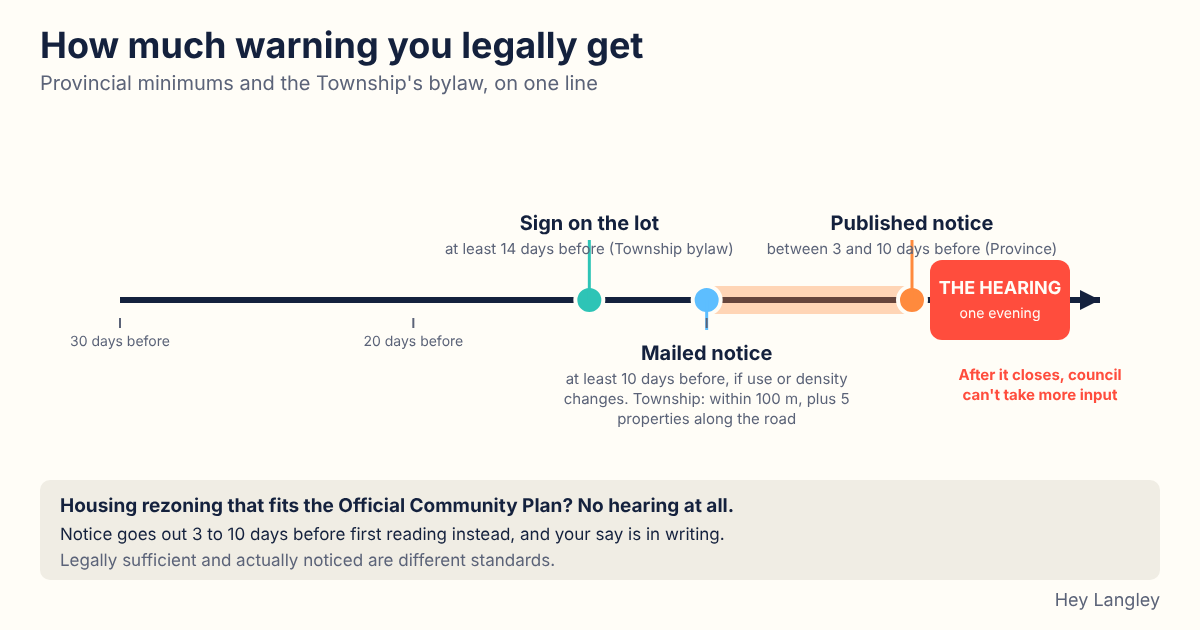
You know the sign. White board, black type, a drawing of a building that is somehow both taller and smaller than it will be. You drive past it for a month without reading it, because it is on a corner where stopping would get you honked at. Then one evening a neighbour mentions the hearing was on Monday, and it went fine, and the thing is approved.
Nobody broke a rule. That is the rant.
Here is how notice actually works, from the Province’s own guidance and the Township’s own bylaw. When a rezoning needs a public hearing, the published notice goes out “not less than three days and not more than ten days” before the hearing. Three to ten days. If the change affects what can be built or how dense it can be, nearby owners and tenants also get mailed notice at least ten days ahead, with “nearby” defined by each municipality. In the Township that means properties within 100 metres of the site, plus at least five properties along both sides of the road. A development sign has to be up at least 14 days before the hearing.
So if you live 110 metres away, on a different street, and you do not take the paper or read the municipal website every week, your legal notice is a sign you cannot safely read and a window of between three and ten days. Then the hearing happens, and the Township’s own page is blunt about what comes next: council “is not permitted to receive further input following the conclusion of a Public Hearing.” Miss the night, miss your say.
It gets one step quieter. Since the Province changed the rules, a council is not allowed to hold a public hearing at all for a housing rezoning that is consistent with the official community plan. That is deliberate: the plan already had its public process, and the idea is to stop relitigating it lot by lot. Fair enough. But it means that for most ordinary rezonings, the thing you might have shown up to no longer exists. The notice still goes out, before first reading instead of before a hearing, and written comments are the route.
None of this is a conspiracy. The notice periods are the provincial minimums and the Township’s bylaw meets them. The system is doing exactly what it is designed to do, which is to be legally sufficient. Legally sufficient and actually noticed are different standards, and the gap between them is where “how did this get approved” comes from.
What would fix it
Opt-in notice by area. Let a resident type in their address and get an email whenever an application or a hearing is filed within, say, 400 metres, not just 100. Both municipalities already have mapping tools that know where every application is; the missing piece is a subscribe button on the map. A plain-language summary at the top of each notice (“12 townhouses, 3 storeys, replacing 2 houses”) would do more for participation than any amount of formal wording. And a standing rule to post the notice on the municipal social accounts the same day it goes in the paper would cost nothing.
Where to act
Right now, the way to not miss it is to go looking. The Township’s Development Activity map shows active applications, and its Public Hearings page explains how to register to speak (online before 6 pm on the day) and where to send written comments ([email protected], accepted up to and during the hearing). The Township’s eNewsletter will tell you about upcoming council meetings. In the City, Let’s Chat Langley City and the planning department’s notices are the equivalents. Our how to follow development applications page walks through both, step by step, and we post hearing dates in What’s On under Civic.