- Where
- Northeast corner of 192 Street and 36 Avenue, Campbell Heights, Surrey. The east edge is the Surrey–Langley border, right behind the homes of west Brookswood
- Size
- About 305 acres (123.6 ha) in five parcels: roughly 220 acres farmed and 84 acres of forest
- Owner
- Government of Canada (Innovation, Science and Economic Development Canada); declared surplus in 2017
- Farmed by
- Heppell's Potato Corp., on a lease renewed one year at a time
- Soil
- About 91% Class 2, prime farmland, according to the Agricultural Land Commission
- In the ALR?
- No. It was left out in 1973, and the ALC declined to add it in 2024
- Other names
- The old "Cloverdale" federal radio site; Campbell Heights North; k'ʷeq'ənəq (Katzie, Kwantlen and Semiahmoo name)
- Status
- No federal decision yet. The farm's lease was extended for another year in August 2026
- Last checked
- October 23, 2026
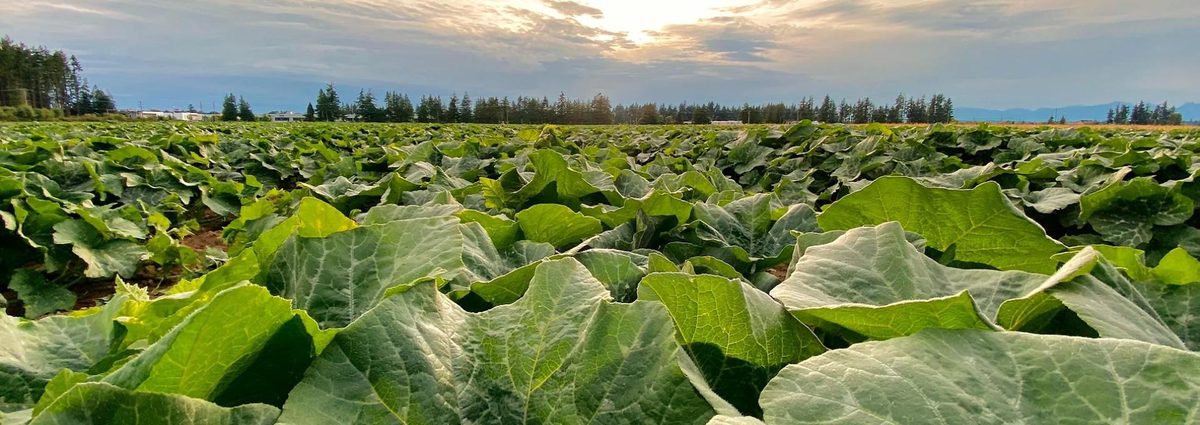
Stand at the west end of Brookswood, near 196 Street, and look over the back fences. That long, flat sweep of potato rows, with forest along its north and east edges, is the Heppell farm. Technically it is in Surrey. In every other way it is part of Brookswood’s back yard: the view, the owls and deer at dusk, and in late May the first new potatoes of the year anywhere in Western Canada.
It is also federal land that Ottawa decided it no longer needs. What happens to it next has been an open question since 2017. This page lays out how it got here.
The land
The property is about 305 acres in five parcels, bounded by 192 Street on the west, 36 Avenue on the south, the Township of Langley on the east and other farmland on the north. About 220 acres are cleared and farmed. The rest is forest on the north and east sides, with Anderson Creek cutting through the steep northeast corner.
The Agricultural Land Commission’s own assessment rates about 91 per cent of the land Class 2, which is prime agricultural soil. It is sandy, drains well and warms early. That is what lets the farm plant in February and March and start digging around the May long weekend, weeks ahead of most of BC.
Here is the odd part. Even though it has been farmed for about 50 years, the land is not in the Agricultural Land Reserve. The ALR was drawn in 1973 and this federal site was left out. It is zoned General Agriculture, but Surrey’s Official Community Plan and the regional growth plan mark it Mixed Employment, and Surrey’s Campbell Heights plan from 2000 shows it as a business park. In other words, the farm is legal today, but every long-range plan on paper expects something else here eventually.
How the federal government came to own it
The land was a federal telecommunications site for decades. Ron Heppell told the ALC’s 2023 hearing that he remembered it being cleared in the 1940s “for overseas telecommunications.” Some news reports describe it as a wartime radar station. The residents’ history at Beautiful Brookswood says the Canadian Overseas Telecommunications Corporation ran a transmitting site here after the war, with big rhombic antennas across the field. It says an undersea Pacific cable made the site redundant in the 1960s, and that it later became a federal radio monitoring station, known locally as the Cloverdale site. Surrey’s 2023 report says simply that the lands were held for communication purposes.
Federal radio monitoring carried on into the 2010s, which is why the land ended up with Industry Canada, now Innovation, Science and Economic Development Canada (ISED). The old station building came down in the mid-2000s.
Fifty years of potatoes
The Heppell family has farmed in the area for more than a century. Tyler Heppell, known online as “Potato Ty”, is the fifth generation. The family began leasing this field in the 1970s. The farm says it has been there since 1974, and Global News describes the tenure as about 50 years. The first crops struggled until irrigation went in. After that it became one of the most productive vegetable fields in the province.
Today the farm grows potatoes, carrots, cabbage, parsnips and squash there. The figures the farm and the City of Surrey have published are big:
- About 50 million servings of vegetables a year, by the City’s and the farm’s estimates.
- About 20 tonnes of potatoes an acre, according to Tyler Heppell in 2022.
- The first local potatoes of the season in Western Canada. In the May-to-early-July window, the farm estimates this land supplies a quarter to a half of BC’s local potatoes, carrots and cabbage, and up to three-quarters of early potatoes and cabbage.
It is also the farm behind Ugly Potato Day, the giveaway of perfectly good but odd-looking produce that started in 2022. In August 2026 it set a Guinness World Record at the Cloverdale Agriplex, with more than 200,000 pounds of Heppell potatoes given away. The farm says 140,000 pounds of the 2025 giveaway came from this field.
Timeline
- 1940s: land cleared for federal telecommunications.
- 1973: the ALR is created. This land is left out.
- 1970s: the Heppell family begins farming it under federal leases.
- 2000: Surrey’s Campbell Heights plan designates it business park.
- 2017: ISED declares the land surplus. Public Services and Procurement Canada (PSPC) is to handle the sale.
- Early 2021: Brookswood residents start Beautiful Brookswood and begin writing to every agency involved.
- June 2022: the farm’s crop manager launches a Change.org petition, which passes 24,000 names within weeks. Ottawa confirms the land is for sale through PSPC.
- July 2022: Surrey council, under Mayor Doug McCallum, passes a motion to designate the farmed land Agricultural in the next plan review and to push Ottawa and the Province for ALR inclusion.
- Fall 2022: a House of Commons e-petition (e-4128) asks Canada to stop the sale, add the land to the ALR, give a local farmer a long-term lease and register a farm covenant. Metro Vancouver’s agricultural advisory committee opposes the sale.
- December 6, 2022: the ALC launches its own proposal to add all 305 acres to the ALR.
- Early January 2023: lawyers for the Katzie, Kwantlen and Semiahmoo First Nations write to object, citing their Aboriginal rights and title.
- January 23, 2023: the ALC holds a public hearing in Langley. Of 365 written submissions, 363 support inclusion. The Greater Vancouver Board of Trade and NAIOP, the commercial real estate association, argue against, citing the shortage of industrial land.
- February 13, 2023: Surrey council, under Mayor Brenda Locke, votes unanimously to support adding the 220 farmed acres to the ALR and leaving the forest out. Surrey’s report estimates the cost to the City at about $53 million in development charges that would not be collected and about $4 million in tax potential.
- 2023 to 2024: PSPC tells residents the sale is paused while ISED works through “recent developments”.
- June 20, 2024: the ALC decides unanimously not to add the land to the ALR “at this time”. It notes that Canada and the three Nations both argued it has no jurisdiction over federal land, but does not rule on that point. It cites the Nations’ negotiations with Canada, and says it could look again if the land goes to anyone other than the Government of Canada or the Nations.
- June 26, 2024: the Katzie, Kwantlen and Semiahmoo First Nations formally ask Canada to return the land to them.
- March 2026: news reports say the lease is year to year and the future unclear. A Surrey councillor mentions talk of a container terminal, warehousing or housing. McCallum, then running for mayor again, puts out a statement backing the farm.
- May 7, 2026: Tyler Heppell appears before the Senate agriculture committee.
- August 28, 2026: Global News reports the lease has been extended for one more year. The petition has passed 90,000 names.
- October 17, 2026: McCallum wins the Surrey mayoralty, and his slate takes seven of eight council seats.
- October 23, 2026: The Tyee reports the family is now asking for a farm covenant on the land and a five-year lease, so it can invest in the field.
Who wants what
The farm. The Heppells want the whole 300 acres kept as farm, forest and creek: through a long-term lease, a covenant that keeps it agricultural whoever owns it, or a route into the ALR. They are asking the Province to back a permanent farm designation and Surrey to change its plan. In 2026 their main asks are the covenant and a five-year lease.
Brookswood residents. The Beautiful Brookswood group wants the land taken out of the Campbell Heights industrial plan and put into the ALR, with the forest kept and linked to Langley’s green corridors. Neighbours told the ALC hearing about the open space, owls, coyotes, deer and pollinators along the field edges. There are no public trails on the property, though.
Katzie, Kwantlen and Semiahmoo First Nations. The three Nations call the land k’ʷeq’ənəq. They describe it as unceded shared territory, a historic gathering and trading place, and the last large piece of federal Crown land in their territory. They say they have been negotiating with Canada for years and want the land returned so they can decide its future for their communities’ economic development and self-government. They have said its future uses are not yet decided. They opposed ALR inclusion as an infringement of their rights. Semiahmoo Chief Harley Chappell has said, “If we want to speak of reconciliation, we must speak of land.” Their campaign page is at katzie.ca/kks.
City of Surrey. Surrey’s councils under two mayors have backed keeping the farmed part in agriculture: the 2022 McCallum motion and the unanimous 2023 vote under Locke. We have not found a record that the Agricultural designation in Surrey’s plan was ever adopted. McCallum’s 2026 platform included a “Farm Local” plan to protect Surrey farmland, and he backed this farm by name in March 2026.
The Agricultural Land Commission. The ALC agreed the soil is prime, then stepped back in 2024 out of respect for the negotiations between Canada and the three Nations. It left the door open if the land goes elsewhere.
The federal government. ISED owns the land and PSPC manages the disposal. Ottawa told the ALC that the Commission has no authority to put federal land in the ALR. It has not announced a decision on the Nations’ request or on any sale. For now it keeps renewing the farm’s lease a year at a time.
Those who favour development. Industry groups, including the Greater Vancouver Board of Trade and NAIOP, argued in 2023 that the region is short of industrial land and that this site was always planned for jobs.
Township of Langley. We have not found a council motion or formal position from the Township, even though the land borders Brookswood.
Where it stands, fall 2026
The land is still federal and still not in the ALR. The farm is planting under a one-year extension. The Nations’ request is unanswered in public, and no sale has been announced. Surrey has a new council that has spoken up for the farm before, and BC votes in a provincial election on October 24.
How to have a say
- The petition: the farm’s Save the Farmland page links the Change.org petition and lists the federal and provincial offices to write to.
- Your MP: this is federal land, so your Member of Parliament is the most direct line. See Langley’s MPs.
- Surrey council: Surrey decides what its plan says the land is for. Contact details are on the City of Surrey’s mayor and council page.
- Township council: if you live in Brookswood and want the Township to take a position, email [email protected].
- The Nations’ view: read it in their own words at katzie.ca/kks.
- The full paper trail: Beautiful Brookswood has collected the history, maps and letters to and from every agency since 2021.
Related
- The Agricultural Land Reserve in Langley, explained
- Brookswood: the guide
- Farming in Langley
- Naval Radio Station Aldergrove, the other big piece of federal land on Langley’s edge
We will update this page whenever Ottawa, Surrey or the ALC makes a move. Something we missed? Tell us.
Last checked October 22, 2026. Spotted something out of date? Tell us.