The 39 acres at Otter Road: what happened to Kisaburo and Tsume Chiba
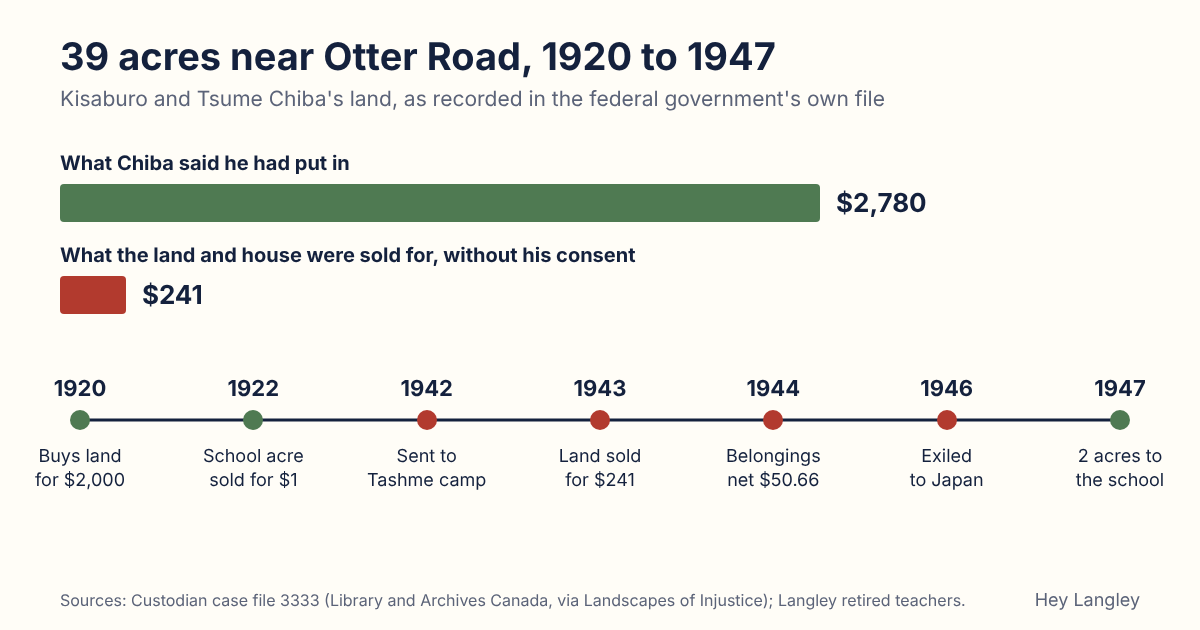
In 1920 a Japanese Canadian farmer bought land at what is now 248 Street and 8 Avenue, and in 1922 joined two neighbours in selling the corner acre for $1 so South Otter School could be built. In 1943 the government sold the rest without his consent, for $241. The federal file tells the story in its own words.
South of Aldergrove, where 248 Street meets 8 Avenue, there is a corner that used to be called Otter and Warner. From 1922 until 1983, South Otter School stood there. Its first acre came from three neighbours: Alexander Macintosh, James Brooks and Kisaburo Chiba. They sold it to the school board for one dollar.
Twenty years later Chiba and his wife Tsume were gone, sent to an internment camp near Hope. Within a year their land was sold without their consent for $241. In 1946 the government put them on a ship to Japan.
We know this because the federal government kept a file on them. The Custodian of Enemy Property opened case file 3333 in Kisaburo Chiba’s name. The file survives at Library and Archives Canada, and the Landscapes of Injustice project at the University of Victoria has scanned it and put it online. Almost everything below comes from that file and a smaller one for Tsume, quoted where we can.
Who they were
Kisaburo Chiba was born on March 12, 1880. Tsume Chiba, born Tsume Oikawa, was born on Christmas Day, 1879. Both were naturalized Canadians. Their mail came by the Coghlan rural route, Rural Route 1, Coghlan, as it did for several Japanese Canadian households along Otter Road.
The 1942 forms give their ages as 62 and 61. On those forms he gave his occupation as “Farm labourer”, employer “Myself”. Hers was “Farmer’s Help, husband”. She signed her declaration with a mark, and a witness wrote beside it: “Witness that the above mark is Mrs Chiba’s.”
The land
The legal description is the west half of the south half of the southwest quarter of Section 11, Township 10, except one acre. That acre was the school. A 1942 government sketch of the property shows “South Otter School” in its southwest corner, with Otter Road along the west side and Warner Road along the south.
Chiba explained how he came by the land in a letter he wrote in January 1946:
“The above property had been purchased by me on March 9, 1920 for the sum of $2000.00 on an instalment plan of $500.00 per year. The total acreage of land was 39 acres of which I had cleared 5 acres. I had spent $430.00 on the house and improvement of the land, and $350.00 for farm tools and fixtures for the house. The total amount expended by me on the property amounted to $2780.00.”
On January 3, 1922, the corner acre went to the school board for $1, and South Otter School opened that May. For two decades the Chibas’ place was the property next to the schoolyard.
It was a small, hard place to farm. In April 1942 Chiba listed his property as a “Two-room frame dwelling house… One woodshed”, with no insurance and no mortgage. Property taxes were about $27 a year, paid at Langley Prairie. An appraiser for the Soldier Settlement Board, the office that would end up buying the land for the Veterans’ Land Act, came out that June. He described the area as “Some fair mixed farms, but most of land is sandy and gravelly”. He wrote that the property “can hardly be classed as a farm” and noted that about five acres had been cleared. An RCMP note in the file records Chiba as a farm labourer working for another farmer, and as “Owner of 39 acre & house.”
The file describes something humbler than a farm: a cleared patch, a two-room house and a woodshed beside the school. Chiba had paid for it a few hundred dollars at a time.
They were not the only ones
The Chibas were part of a Japanese Canadian farming community scattered through Langley before the war. The Township’s heritage study notes families in Fern Ridge, Coghlan and West Langley (our history of Langley has the bigger picture). The Landscapes of Injustice records list families on Otter Road and Coghlan Road, among them:
- Seizen Oyama, a “self-employed strawberry grower” on Otter Road.
- Hoshio and Uta Nako, who farmed on Otter Road.
- The Takeda family, on Otter Road and Coghlan Road.
- The Kinoshita and Morishita families, who farmed around Coghlan, and the Yokoyama family on Coghlan Road.
A young man named Masatsugu Hayashi was recorded as working for the “Coghlan Farmer’s Association”. Historian Anne Doré, writing in BC Studies and citing historian Toyo Takata, describes small Japanese farmers’ associations, called nokai, at Mount Lehman, Clayburn and Coghlan. Through them, Fraser Valley berry growers pooled their crops and bought supplies together. By 1934, Doré writes, Japanese Canadian farmers grew about 85 per cent of the Fraser Valley’s berries.
Farther west there were families at Langley Prairie and Milner. At Milner, the community built a hall on land belonging to Banjiro Eto. Its organ was sold at a Langley auction in May 1944 for $11. In December 1948 the government mailed Mr. Eto, by then living in Toronto, a cheque for $232.59 for the hall and the organ.
1942: removal
After Japan’s attack on Pearl Harbor, the federal government ordered everyone of Japanese ancestry out of a 100-mile zone along the BC coast. The order came on February 24, 1942. Langley was inside the zone. About 22,000 people were removed, most of them Canadian citizens. None had been charged with anything.
The Chibas filed their property declarations in April 1942. Kisaburo noted that the key to the house “will be left in care of my neighbour Mr. Crawford.” A man who wanted to buy the land wrote to the government that month. He reported that Chiba “will not talk now just says expect to go any day but that he will be back here very soon.”
Their RCMP sheets give “Oct 20/42” as the date they were removed, and their address as Tashme, near Hope. It was the largest of the BC internment camps and held more than 2,600 people.
1943: the land is sold
At first the Custodian was supposed to hold Japanese Canadian property in trust. In January 1943 the federal cabinet changed that and authorized the Custodian to sell it, without the owners’ consent.
In the Fraser Valley, that meant one large deal. The federal Veterans’ Land Act was buying farmland to settle returning soldiers. In 1943 it bought 769 Japanese Canadian farms in a single bulk purchase for $850,000. Those farms had been assessed for taxes at more than $1.2 million. Yasutaro Yamaga, the one Japanese Canadian on the advisory committee, resigned in protest as the deal took shape.
The Chibas’ 39 acres were part of it. The file records the land as “Sold to the Director, Veterans’ Land Act for $241.00 Cash as of January 1st, 1943.” That was below the appraisers’ own figure of $245, and far below the municipal assessment of $1,200. A neighbour had offered $700 for it in April 1942. A $3 registration fee was taken off, and $238 was credited to Chiba’s account with the Custodian, an account he did not control. Further fees of $1 and $15 were charged later. He was told by letter in April 1944, at Tashme.
That June, his belongings were auctioned in Abbotsford: bowls, a wheelbarrow, tubs and pails, kegs, two Congoleum rugs, a table, a dresser, a Morris chair, a bed and mattress, a box stove. After the auctioneer’s fees, advertising and moving costs, the account was credited $50.66.
“Without any consent from me”
On January 8, 1946, Chiba wrote from Tashme to the Swiss Consul General in Montreal. Switzerland was then looking after the interests of Japanese nationals in Canada. After setting out what he had paid and spent, he wrote:
“Without any consent from me and without consideration, the Custodian sold the property for $241.00 as per statement of April 13, 1944. I feel that the difference between the two figures is too large and that the sale price was not a fair valuation for said land.”
The consul forwarded the letter to Ottawa and asked for “a readjustment in the price”. Ottawa asked the Custodian’s Vancouver office for a report. The office replied in February 1946 that the property had been sold “at the valuation of $241.00”. Nothing in the file shows the price was ever changed.
1946: exile
In 1945 the government pressed people in the camps to choose between moving east of the Rockies and “repatriation” to Japan. Almost 4,000 people were sent to Japan, most in 1946, many of them Canadian-born or, like the Chibas, naturalized Canadians.
Kisaburo and Tsume Chiba sailed from Vancouver on May 31, 1946. Both were 66. Their RCMP sheets are stamped “Returned to Japan”, with a ship name that is partly legible and appears to be the Marine Angel. We found no record that either of them came back to Canada.
From Otter Road, Seizen Oyama, the strawberry grower, was sent to Japan in December 1946. Nikizo Morishita of Coghlan Road was sent that August. Japanese Canadians were not allowed back to the coast until April 1, 1949.
What became of the land
In 1947 the Veterans’ Land Act sold two acres of the former Chiba property to the Langley school board for $100, to enlarge the South Otter schoolyard. That works out to about $50 an acre. Four years earlier the same land, house included, had been sold out from under Chiba for about $6 an acre. We have not found what became of the remaining 37 or so acres.
South Otter School closed in 1983. The land around the corner is private property today, so please look from the road.
Apology and redress
On September 22, 1988, Prime Minister Brian Mulroney stood in the House of Commons and offered Japanese Canadians “the sincere apology of this Parliament”. The redress agreement paid $21,000 to each eligible survivor and funded community and anti-racism programs. In 2012 the BC Legislature passed its own unanimous apology. In 2022 the province committed $100 million toward survivors’ health care, heritage sites and school curriculum.
We could not find any plaque, motion or exhibit in either Langley that marks this part of local history. If you know of one, or if you are connected to any of the families named here, we would like to hear from you.
Read the file yourself
Case file 3333 is online in full, 25 scanned pages: the declarations, the appraisal and its sketch map, the auction sheet and Chiba’s letter. Landscapes of Injustice has thousands of these files. Search its archive for “Coghlan”, “Otter”, “Milner” or “Langley Prairie” and you will find more Langley names.
A note on words: this history has often been told as land “confiscated” from Japanese Canadians. In the Chibas’ case, the paperwork shows the land was seized by the Custodian, then sold without their consent for a price they did not agree to. The money went into an account the government controlled. The 1942 appraisal also uses a racial slur, which we have not reproduced.