Hats in the air at Fort Langley: the royal train, 1939
A crowd of young men waving at the back of a railway car at Fort Langley. The archive calls it 'Their majesties': King George VI and Queen Elizabeth on the 1939 royal tour, passing through on the CN line.
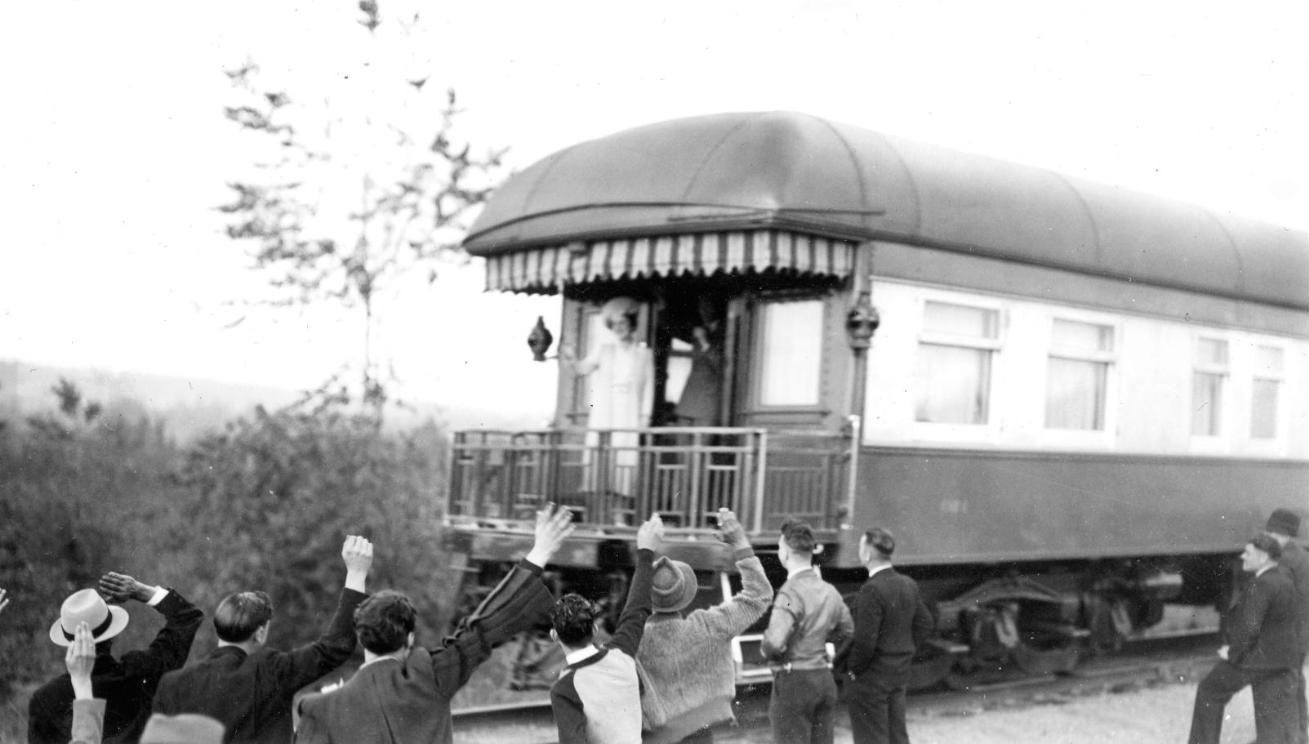
Start with the hats. At the bottom left of the frame a young man holds a white fedora up over his head, and the arm next to him is up too. Count across and there are at least half a dozen hands in the air, most of them belonging to young men in work jackets and sweaters, all turned toward the back of one railway car.
The car is what they came to see. It has a rounded roof, a striped awning over the rear platform and a brass-railed balcony. Standing at that rail in a pale coat and hat is a woman with one arm raised. A second figure is just visible in the doorway behind her. The City of Vancouver Archives catalogues the photo simply as “At Fort Langley : Their majesties”, dated 1939, so the people on that platform are meant to be King George VI and Queen Elizabeth.
Why the King was in Fort Langley
The 1939 royal tour was the first time a reigning monarch had come to Canada, and the King and Queen crossed the country by train in May and June of that year, with Prime Minister William Lyon Mackenzie King travelling with them the whole way. They spent May 29 in Vancouver and went on to Victoria by ship.
Coming west, the royal train had used the Canadian Pacific line. Heading home, it ran east on the Canadian National line along the south side of the Fraser, which goes straight through Fort Langley. The train timeline compiled from the tour itinerary has it leaving the coast on May 31, by way of Vancouver, New Westminster, Mount Lehman and Chilliwack, on the way to Jasper. The Langley Heritage Society calls the Fort Langley stop a brief whistle stop, and adds that it was “more likely a slow crawl by the train”.
That fits the picture. Nobody is on a platform here. The crowd is standing on gravel right beside the track, the car is still on the rails in front of a hedge of scrub and young trees, and everything at the far end of the car is a little soft, as if it was moving.
The rest of the frame
To the right of the wavers, two young men stand with their hands at their sides, just watching. Further right, two older men in dark coats and caps stand at the end of the car, closer than anyone else. We don’t know who they were. They could be railway men, police or local officials, and the archive record doesn’t say.
Behind the car the land falls away to a hazy line of hills, and on the left a bare-branched tree sticks up out of the brush. It’s late spring, and the brush is in full leaf.
The photographer
The photo was taken by William Orson Banfield (1897 to 1983), and it is one of a run of prints the City of Vancouver Archives holds from Fort Langley in 1939, all titled “At Fort Langley”. Others in the series show the royal train itself, a frame catalogued as No. 5117, the pilot train that ran ahead of it, Mounties on duty, and Mackenzie King. Taken together, they suggest Banfield was standing trackside for a while, not snapping one lucky frame.
What the town put on
The Heritage Society says a grandstand was put up near the track for the day and a community band “blasted a rousing welcome”. Among the people waiting was the Fort Langley community band. Twelve years later, in 1951, Princess Elizabeth and Prince Philip gave Fort Langley a royal wave from the train too.
Where this is today
The village’s station on that line was the Canadian Northern Railway station, built in 1915 when the railway decided Fort Langley had enough business to justify one. Canadian National took over the line after Canadian Northern went broke near the end of the First World War. Passenger service was cut back hard in the 1970s and 1980s and the station eventually closed. It was slated for demolition, but the Langley Heritage Society saved it, moved it 240 metres and restored it. The Township owns the building and the society runs it.
You’ll find it at 23245 Mavis Street, on the corner of Glover Road, with the tracks and the Fraser just to the north. Stand on the platform side and look along the rails toward the river: somewhere along this stretch, a crowd of young men threw their hats in the air.