A picnic for a hundredth birthday: Old Fort Langley, July 31, 1927
Eight people on the grass under a big tree, a coffee pot, a car and a flat of berries. The note on the back says 'Old Fort Langley (100th anniversary)', and two of the names written there belong to Vancouver's history writers.
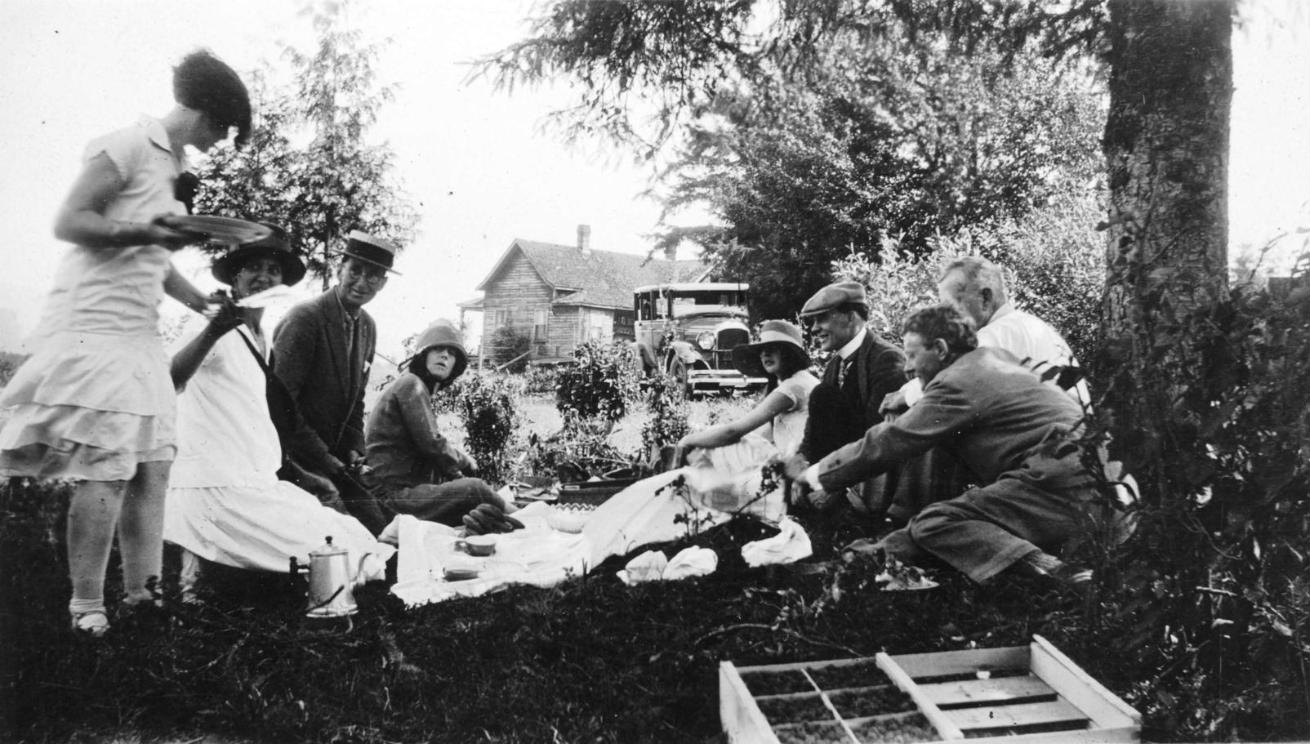
The woman on the far left has just stood up with a plate in her hand. Everyone else is down on the grass. There’s a white cloth spread out, a tall metal coffee pot in the front left corner, some food on the cloth, and right at the bottom of the frame, a wooden flat divided into little square boxes, the kind berries come in. Behind them, past a row of bushes, a boxy 1920s car is parked in front of a weathered wooden farmhouse with a brick chimney. The whole party sits in the shade of one large tree.
On the back of the print someone wrote where they were and why: “Old Fort Langley (100th anniversary)”. The City of Vancouver Archives dates it to July 31, 1927.
A hundred years and two days
The Hudson’s Bay Company party that built Fort Langley came up the Fraser on the schooner Cadboro. There were 25 of them under James McMillan, and they reached the site on July 29, 1827, according to Parks Canada’s history of the fort by Mary K. Cullen. This picnic is a century plus two days later.
Those first men built on the south bank, at what’s now Derby Reach. In 1839 the company put up a new fort two and a half miles upstream and moved out of the old one, which Douglas described as dilapidated. That second site is the Fort Langley National Historic Site in the village today. The fort was named a national historic site in 1923, four years before this picnic, and its one surviving original building opened to the public in 1931.
Fort Langley wasn’t built in empty country. Parks Canada’s history notes that the Kwantlen people pressed the traders to deal in salmon and cranberries as well as furs, and Chief Whattlekainum is named as pushing for it. Salted salmon went to Hawaii and cranberries to California. A hundred years on, a berry flat sitting in the grass at a Fort Langley picnic is an easy thing to overlook, but the fruit trade here is older than the province.
Who’s on the blanket
The back of the photo also names six people: “Miss Houghston, W. Corbett, D. Nelson, W. Pilkington, Capt. Eddie, Noel Robinson.” The archive doesn’t say who is who, and there are eight people in the frame, so we won’t guess at faces.
Two of the names stand out.
Noel Robinson (1880 to 1966) was a Vancouver journalist who wrote about the city’s people and events, and the Roedde House Museum describes him as a BC historian and playwright too. A writer like him at an anniversary picnic is no surprise.
D. Nelson is very likely Denys Nelson. In 1927 the Art, Historical and Scientific Association of Vancouver published his 31-page book Fort Langley, 1827–1927: A Century of Settlement in the Valley of the Lower Fraser River, written for the centenary. The photo itself came to the City of Vancouver Archives from the Vancouver Museum in 1986. We haven’t found a record that puts Nelson at this picnic by his full name, so treat it as a strong likelihood, not a fact.
The other four names (Miss Houghston, W. Corbett, W. Pilkington and Capt. Eddie) we couldn’t trace. If one of them is your great-grandparent, we’d love to hear from you.
Where was the picnic?
The caption says “Old Fort Langley”. That’s the name still used for the first fort’s site at Derby Reach, and the farmland around it. The photo doesn’t show anything we can pin to one spot, though: just a farmhouse, a tree and a car. So we can say the party was at or near old Fort Langley, but not which field.
See it today
The first fort’s site is in Derby Reach Regional Park, where Metro Vancouver marks it with a cairn and exhibits in the park’s Heritage Area. The Fort to Fort Trail runs along the river from there to the national historic site in the village, which makes it easy to cover both forts in one walk. Bring a coffee pot if you like.