Langley in the First World War: the farm boys, the fishermen and the 41 names in stone
About 400 men from a farming district of fewer than 4,000 people went to the First World War, and roughly one in ten did not come home. Who they were, where they fell, and how Langley chose to remember them.
In the summer of 1914, Langley was a scatter of farms, logging camps and small settlements strung along the river and the old roads: Fort Langley, Milner, Murrayville, Langley Prairie, Aldergrove, Glen Valley. About 3,500 people lived here. Over the next four years, roughly 400 local men and some nursing sisters went to war. By the historian Warren Sommer’s estimate, about one in ten of them did not come back.
That is the whole of it in two sentences. The rest of this piece is the people.
Who went
Many of Langley’s recruits were young British immigrants who had come out in the years before the war to take up land, and who answered the call of a country they had only recently left. Others were born here. They were farmers, loggers, mill hands and fishermen. Some of them were boys. In Langley Prairie, today’s Langley City, more than half the adult men had served by the time the war ended, and British Columbia as a whole sent a larger share of its men than any other province.
They went with the battalions raised around the Fraser Valley and Vancouver: the 47th and the 131st out of New Westminster, the 29th, known as Tobin’s Tigers, the 72nd Seaforth Highlanders, the 102nd, the 54th, the 2nd Canadian Mounted Rifles. A few joined the air services. The 47th Battalion’s band would later play when the town unveiled its memorials.
Warren Sommer spent years tracing them for his 2017 book Canucks in Khaki, and in the process linked about a hundred names to Langley that no one had connected before. Much of what follows rests on his work, the Langley Heritage Society’s, and the records of the Canadian Virtual War Memorial.
Eight of the names
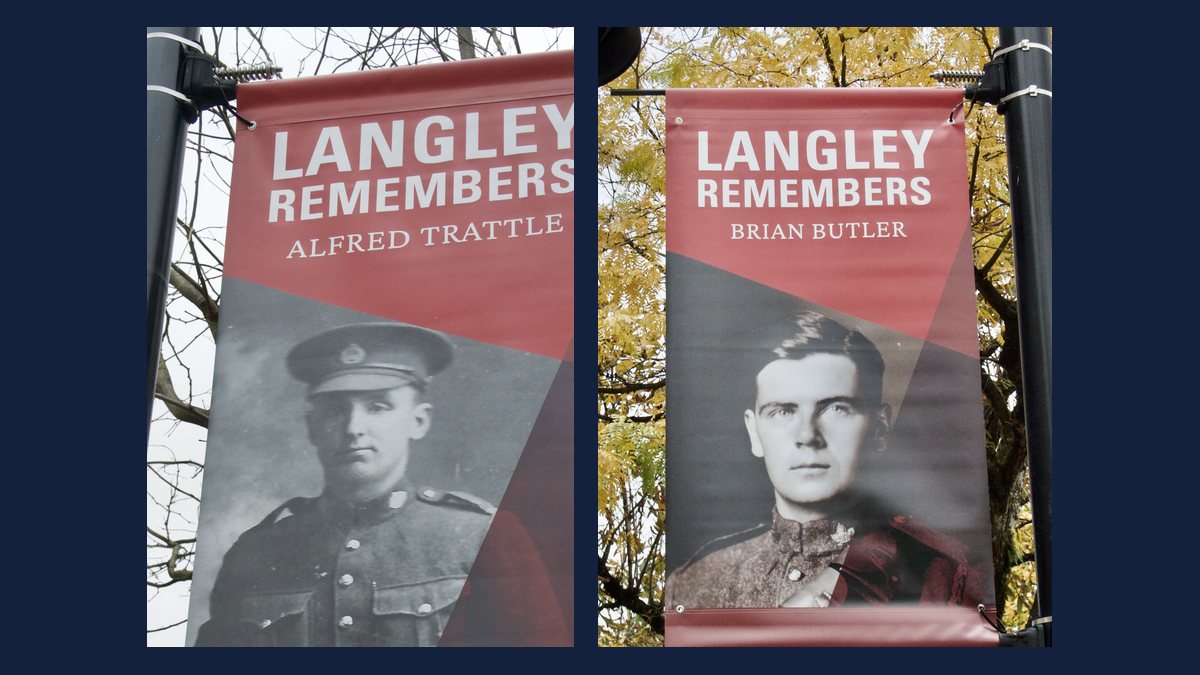
Private Alfred William Trattle, 47th Battalion. Alf Trattle grew up in London’s East End and came to Canada in 1911 with his wife, Emma. He worked on the Mufford brothers’ farm at Milner, then on two acres of his own in Fort Langley. He enlisted at New Westminster in March 1916, trained at New Westminster and Vernon, and reached the front in December. He was killed on May 23, 1917, at 29, and is buried at Villers Station Cemetery in France. He left two small sons, Alfred and William John. In 1920, those two boys unveiled the memorial cross at Fort Langley.
Sergeant Jesse Wright, 7th Battalion. Emma Trattle’s brother. A fisherman and farmer at Fort Langley, he enlisted within days of the declaration of war and went overseas with the First Contingent. He fought at Second Ypres in 1915 and was made sergeant at the end of March 1917. He was killed on April 14, 1917, in the days after Vimy Ridge, at 22. He has no known grave; his name is carved on the Canadian National Vimy Memorial. A Langley Fine Arts teacher, Robyn Lorensen, has written a song about the two brothers-in-law.
Private Eugene Lawrence Allard, 2nd Canadian Mounted Rifles. A Fort Langley logger known as “Shorty,” he stood five foot four. The Langley Heritage Society traces his family to Ovid Allard, the Hudson’s Bay Company’s Chief Trader at Fort Langley. He was killed on October 30, 1917, helping hold a support line east of Ypres during the Passchendaele fighting. He has no known grave and is named on the Menin Gate. His brother Alexander was gassed and died in 1924; his youngest brother, Billy, won the Military Cross at Vimy. Allard Crescent carries the family name.
Private Brian Harper Butler, 29th Battalion. Born in Leeds, the son of a minister, the Rev. Henry Butler, he enlisted in Vancouver in 1915 and gave his occupation as woodsman. Wounded in April 1917, he died in hospital at Boulogne on April 23. A friend’s tribute in the Vancouver Province said simply: “He loved British Columbia and died for her.”
Major Arthur Thomas Johnston, 102nd Battalion. A Murrayville shopkeeper who had already served in South Africa, Johnston helped organise Langley’s early volunteers. He was killed on September 2, 1916, and is buried at Reninghelst in Belgium. His family received the bronze Memorial Plaque that bereaved families called the dead man’s penny.
Private George Lewis Warner, 72nd Battalion. Born in Langley in 1896, the son of Gustav Alfred Warner and Mary Olson of Aldergrove. He enlisted in February 1916 and died in England on May 5 that year, at 19, before he ever reached France. He is buried in Liverpool.
Private John Bertram “Jack” Carvolth, 54th Battalion. Killed on March 1, 1917, at 28, and buried at Villers Station Cemetery, the same cemetery where Alf Trattle would be laid to rest less than three months later. He and Fred Roberts, the only son of Langley Prairie’s postmaster, were killed within nine months of each other.
Cadet William Elton Berry, Royal Air Force. The son of John and Lydia Berry of Langley Prairie. He was 18, a cadet with the Royal Air Force in Canada, when he died of illness on October 27, 1918, a fortnight before the Armistice. In 1920 a younger Berry brother unveiled the memorial at Murrayville.
And there are more, each with a story: Captain Hector Jackson, an Aldergrove homesteader who won the Military Cross at Passchendaele and survived the war, only to be killed in a road accident in Vancouver afterwards; Private John Topping, 19, of the 47th; William Wilson, a Fort Langley farmer; Alexander Ross of Aldergrove, who wrote a letter home by torchlight in January 1918 and was killed by a stray shell two days later.
At home
Langley’s war wasn’t only fought in France. A local branch of the Canadian Patriotic Fund, chaired by the farmer Robert Wark, helped the families of men in uniform. Women knitted, baked and put up preserves for the men overseas, and took on work on the farms. Boys too young to enlist signed up as Soldiers of the Soil to work the harvest. A section of the B.C. Horse was expanded to guard against enemy agents.
When the Armistice came, Murrayville celebrated by burning a stuffed effigy of the Kaiser, made by a returned soldier, Quint Gosling. Florence Cassidy described it in a letter to her brother Harry, still overseas.
After the war, some of the men came home with wives they had met in Britain. The Langley Heritage Society has traced several of these war brides, women like Jessie Wood, who married Henry Selby Hele, a Military Medal winner from Langley Prairie.
Remembering them
In 1920, two returned soldiers, Dr. Benjamin Marr and the municipal clerk Archie Payne, led a drive to build a memorial. The money came in within a week. The result was a pair of matching stone Celtic crosses, one in the Fort Langley cemetery and one in the Murrayville cemetery, unveiled in September 1920 (some records date them to 1921). Both carry the same words:
SACRED TO THE MEMORY OF THE MEN FROM LANGLEY DISTRICT 1914-1918. THEY DIED THAT HONOUR MIGHT LIVE. IF YE KEEP NOT FAITH WE SHALL NOT SLEEP.
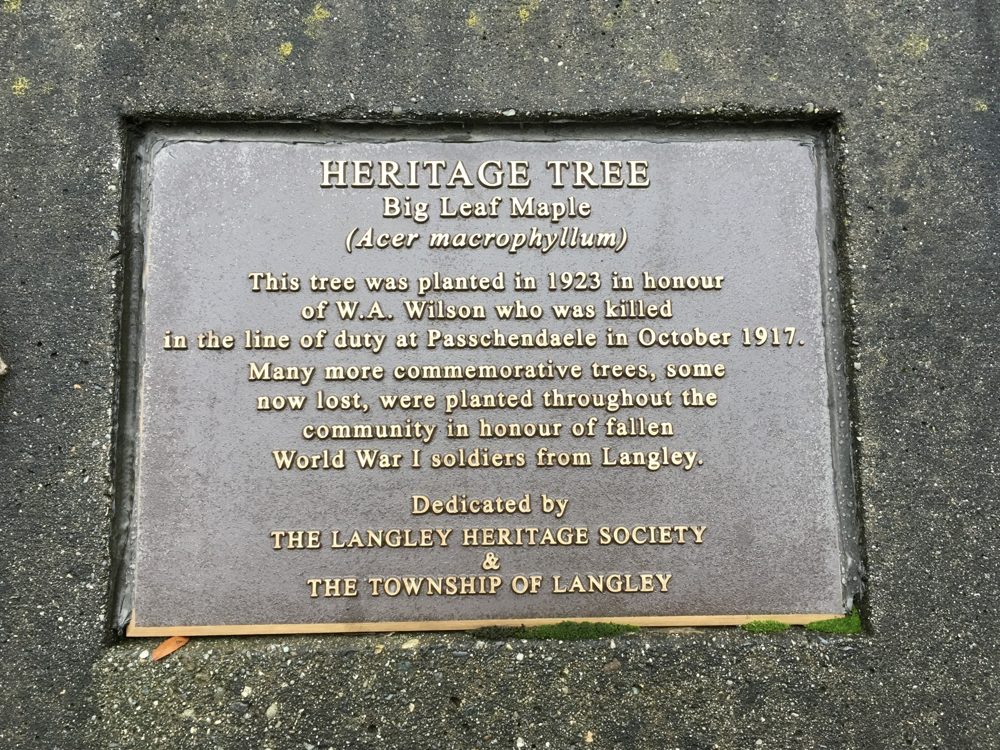
Marr and Payne didn’t stop at stone. In 1923 they had maples planted in honour of individual soldiers, and streets were named for the dead. Four of those memorial maples are recorded today: Trattle’s at 96 Avenue and Trattle Street, Wright’s at 96 Avenue and Wright Street, Johnston’s at 216 Street and Glover Road, and Wilson’s, which was milled into a memorial bench now standing at Heritage Manor in Fort Langley. Eighteen horse chestnuts along Glover Road were planted as a living memorial too. When you drive down Allard Crescent, Trattle Street, Wright Street or Carvolth Road, you are reading the cenotaph.
Every spring, Langley held a Memorial Day service at the crosses, until a 1931 federal law fixed the date as November 11. Returned men formed the Great War Veterans Association, a forerunner of the Royal Canadian Legion.
The names
These are the First World War names as they appear on the Fort Langley and Murrayville crosses, recorded in the National Inventory of Canadian Military Memorials.
Killed in action: E. Allard · W.E. Berry · Harry Brawn, M.M. · C.H. Brown · Hew M. Bradshaw · S. Boundy · T. Brand · B. Butler · Jack Carvolth · C.H. Davis · V.C.L. Davis · M. Gueho · D.W. Howes · J.C. Henderson · D. Howell · A.T. Johnston · Hy Johnston · N.W. Kendall · W. Lee · Gordon McDonald · J. McDonald · J. McKay · A. McIntyre · F.H. Read · D. Robertson · Fred O. Roberts · C.E. Sellers · Hazie R. Simmonds · L. Swain · J. Topping · S. Tyres · A.W. Trattle · G.H. Topham · J. Wright · G. Warner · Monty Wix · H.M. White · W. Wilson
Died since the Armistice: E.W. Berry · Frank W. Glover · H.J.R. Jackson, M.C.
For the Armistice centenary in 2018, Warren Sommer was to read aloud the names of Langley’s First World War dead, 44 by his count, at the Fort Langley ceremony.
Go and see
- The crosses: Fort Langley Cemetery, 23105 St. Andrews Avenue, and Murrayville Cemetery, 21405 44 Avenue. Both hold Remembrance Day ceremonies; see our ceremony guide.
- The trees: 96 Avenue at Trattle and Wright streets in Fort Langley, and 216 Street at Glover Road in Milner.
- The book: Canucks in Khaki by Warren Sommer (2017). The Langley Heritage Society gave a copy to every school in the district.
- The records: search any name on the Canadian Virtual War Memorial, which holds service details, photos and letters.
We will remember them.