Why Langley grows so many mushrooms
A barn fire on 36 Avenue this week was a reminder that the windowless buildings along Aldergrove's side roads are farms. Here's what grows inside them, why the industry settled on this corner of the valley, and why American growers are suddenly paying attention.
- What's grown
- Mostly Agaricus: white button, cremini and portabella are the same species at different sizes and colours
- How big
- BC sold $226.5 million of mushrooms in 2024, about 30 cents of every mushroom dollar in Canada; only Ontario grows more
- Where in Langley
- Concentrated around Aldergrove and the Township's south-east: the 2010 land-use inventory counted a dozen properties farming mushrooms as their main activity
- The big one
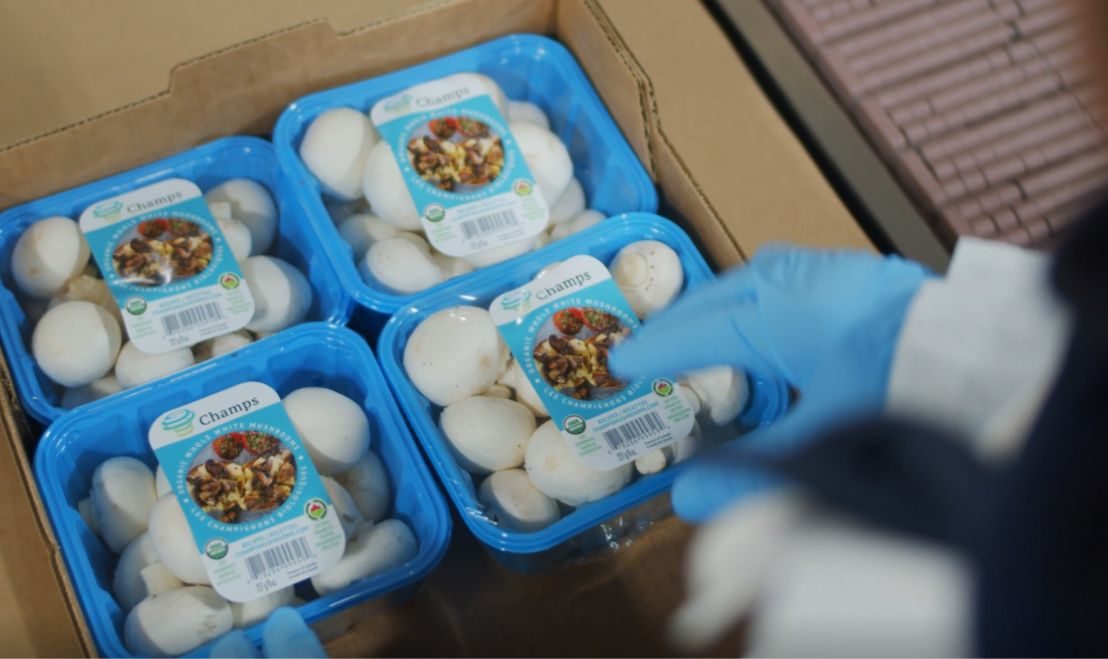
- Champ's, founded in Aldergrove in 1998, now part of South Mill Champs, the largest mushroom grower in Western Canada
At 6 am on Tuesday, November 3, a barn on a mushroom farm off 36 Avenue caught fire. There was no hydrant, so the Township shuttled water in by tender, called a second alarm and sent at least ten trucks and 24 firefighters. Nobody was hurt, the building was a write-off, and 36 Avenue stayed closed between 256 and 264 Street until early afternoon. For a lot of people that was the first time they’d thought about what goes on in those long, windowless buildings on Aldergrove’s side roads. Here’s the answer, in the order people usually ask.
What’s in the barns?
Mushrooms, and almost nothing else. The Province’s farm-practice guide describes the standard set-up: an insulated building divided into sealed growing rooms, each with five to seven tiers of shelving stacked with compost, and every room’s temperature, humidity and air managed by machine. Mushrooms don’t need light to grow, which is why the buildings have no windows and look nothing like a greenhouse. The crop is picked by hand, cooled right away and shipped the same day, and the guide notes that the fans, coolers and trucks can run around the clock.
The crop is nearly all one species, Agaricus bisporus. A white button, a brown cremini and a portabella are the same mushroom at different ages, sizes and strains. A few specialty varieties go to restaurants, but the button is the business.
Why here, of all places?
Four reasons, and the first is the one nobody guesses: chicken manure.
Mushrooms grow on compost, and the compost recipe is straw and hay, manure, gypsum and other nitrogen sources, cooked down until it’s ready for spawn. The Fraser Valley is poultry country, and the Province says about 2,000 cubic yards of dry poultry waste goes into mushroom compost every week, which it describes as a useful way of soaking up excess nutrients in the valley. The growers get their main ingredient from next door; the poultry farms get rid of it.
Second, the land. Three quarters of the Township sits in the Agricultural Land Reserve, and most of those parcels are under ten acres. The 2010 inventory the Province did with the Township makes the point directly: small lots don’t suit dairy or field crops, but they suit intensive operations that don’t need much ground, and it names mushrooms first. A mushroom farm is a factory that happens to be classed as farming, so a 10-acre ALR lot that can’t support cattle can support a very large payroll. The Township’s own agricultural strategy singles out “non-soil based” farming, greenhouses and mushrooms, as a big share of its farm revenue.
Third, the market. Vancouver is an hour away and the Aldergrove border crossing is at the bottom of 264 Street, which matters when the product has a shelf life measured in days.
Fourth, momentum. Once a composting plant, a spawn supplier and a trained workforce exist in one area, the next farm goes up beside them.
How big is it?
Bigger than the valley lets on. Statistics Canada’s 2024 survey counted $749.5 million in Canadian mushroom sales, the ninth straight annual increase, with Ontario and BC together accounting for almost 93 per cent of those sales. BC’s share was $226.5 million, up 7 per cent in a year. The industry employed 6,150 people nationally, almost all full-time. In 2019, by the same survey, BC grew nearly 43 per cent of Canada’s mushrooms by weight.
Locally, the name to know is Champ’s. The Quach family started it in Aldergrove in 1998 with, in the company’s words, a packing room and a few trucks. By the time it merged with Pennsylvania’s South Mill in 2018, the Advance Times reported, it ran 12 indoor farms, a composting operation and a distribution centre with more than 600 employees, producing 35 million pounds a year; the company now puts its output above 40 million pounds and calls itself the largest grower in Western Canada. Its head office is at 3151 260 Street.
Why does Aldergrove sometimes smell like that?
Compost. The stage where straw and manure break down is the pungent part, and it’s regulated: BC has a Mushroom Composting Pollution Prevention Regulation under the Environmental Management Act that sets minimum standards, and the Province’s guide tells growers to cover or contain spent compost so that runoff doesn’t reach ditches and streams. Used compost goes out as fertilizer and soil conditioner rather than being stored, because stored piles attract flies and rodents.
Why are American growers upset?
Because BC got good at this. The Narwhal reported this summer that BC farms adopted the Dutch method, metal shelving in sealed, computer-controlled rooms, while most American growers still use older wooden shelves, and that South Mill Champs alone sends about 22,675 tonnes a year south. In September 2025 a group of US producers petitioned the US Department of Commerce, arguing Canadian mushrooms are subsidized and sold below fair value. Commerce agreed on a preliminary basis in May 2026, then in July set a preliminary anti-dumping margin of 8.71 per cent on Champ’s Fresh Farms and its Loveday affiliate, with an “all others” rate of 8.26. Mushrooms Canada called the subsidy finding deeply flawed, and BC’s agriculture minister has pointed out that the supports in question, like the PST exemption on farm equipment, apply to every farmer, not mushrooms in particular. The final decision is due around December 3, 2026. Nearly all Canadian mushroom exports go to the US, so an Aldergrove farm has a lot riding on that date.
What it means for the rest of us
The barns aren’t going anywhere; the ALR and the economics both say so. If you’re buying a rural property in south-east Langley, the Right to Farm Act protects a mushroom farm’s normal practices, trucks and compost included. If you’re a gardener, spent mushroom compost is one of the cheapest soil amendments around. And if you want to understand why the Township fights so hard over every ALR exclusion, the mushroom barns are a good place to start: our ALR explainer covers the rules, and our farming and agriculture page has the bigger picture. For the neighbourhood itself, see the Aldergrove guide.