Brookswood without the wood? An open letter to the new Township council
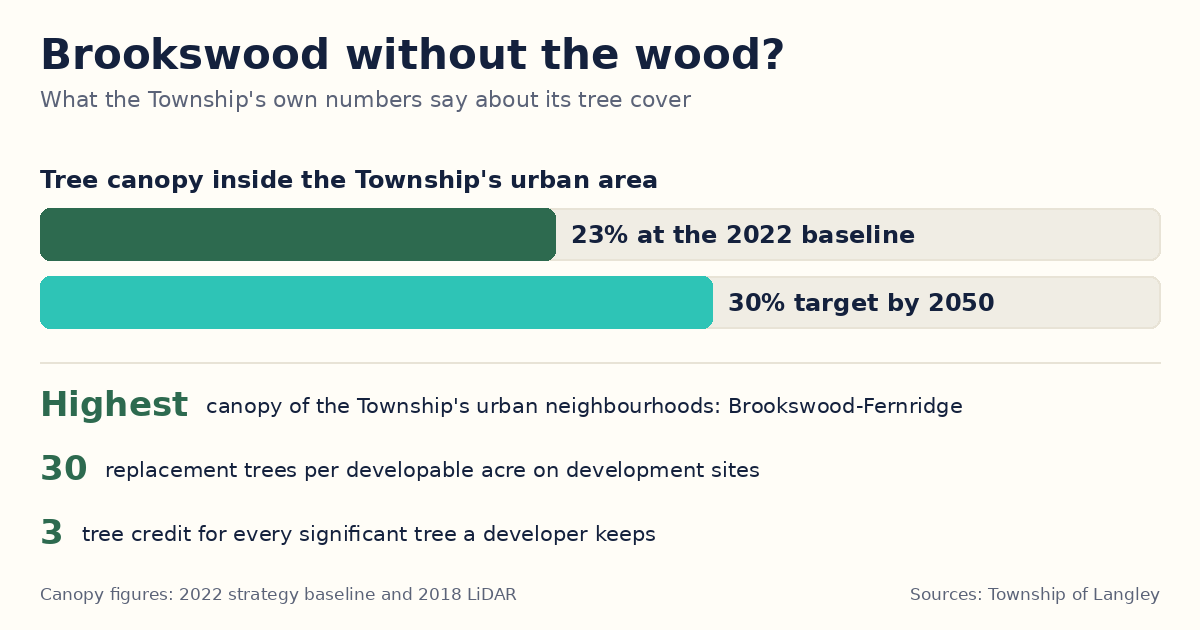
Brookswood has the most tree cover of any urban neighbourhood in the Township, and it's about to grow. Five practical asks for the new mayor and council, so the woods come along for the ride.
This is an opinion piece, written as an open letter. It’s about a planning question, not about any person, builder or property owner.
To the Mayor and Council of the Township of Langley,
Congratulations, and welcome. As you settle in, a long list of things will land on your desks. Here’s one that doesn’t have a line item yet: how does a neighbourhood with “wood” in its name keep its trees while it grows?
We’re not writing to keep anyone out. More neighbours means more kids at the schools, more people walking the pond, more customers on 200 Street. We’re writing because the thing that makes Brookswood feel like Brookswood, the tall firs and cedars over the rooftops and down the side streets, is easy to lose a lot at a time and very slow to get back.
You already have good tools
Township staff have done solid work on this, and it’s the right place to start.
- Brookswood leads on trees. The Township’s 2021 forest assessment, built on 2018 laser mapping, found canopy cover highest in Brookswood-Fernridge of all the Township’s urban neighbourhoods.
- There’s a target. In May 2022 council unanimously approved a Community Forest Management Strategy. It measured canopy at 23% inside the urban area and set a goal of 30% by 2050.
- The neighbourhood plans say the right things. The Booth plan describes a small-town, forested character with tree-lined roads, and links the neighbourhood forest to protecting the groundwater under it. The Fernridge plan calls for a canopy check every five years, planting targets for parks and school sites, and a mix of species so that no single one makes up more than 10% of the neighbourhood’s trees.
- The development rules have teeth. A certified arborist has to be involved early. Site design “must prioritize the retention of suitable trees.” No clearing before final approval. Thirty replacement trees per developable acre, half of them conifers, a three-tree credit for every significant tree kept, and monthly monitoring reports while the work goes on.
That’s a good framework. The question is what it adds up to on the ground, one application at a time.
What one application shows
Take a 12-lot application that came to council on July 27 (Report 26-96, near 196 Street and 32 Avenue). The preliminary tree plan counted 46 significant trees on the site and proposed keeping none of them. It offered 72 replacement trees and 20 new street trees instead.
To be fair to everyone involved, the staff report didn’t stop there. It requires the applicant to find and build in ways to keep significant trees on the lots, in the boulevards and along the greenway as the detailed plans are drawn up. We don’t know yet how that one ends, and we’re not singling it out. It’s just a clear picture of the gap the rules are trying to close. On paper, 46 trees become 92. From above, a mature fir and a freshly planted sapling are not the same tree, and won’t be for decades.
Five things we’d ask for
1. A Brookswood canopy report card. The Fernridge plan already asks for a canopy assessment every five years. Do it for all of Brookswood-Fernridge, publish it, and use the same boundary and method each time so residents can see which way the line is heading. The most recent neighbourhood figure we can find comes from 2018 imagery.
2. Show the options before the lot lines are drawn. When an application reaches council, include a short, plain summary: how many significant trees are on the site, how many will stay, and what other layouts were looked at to keep more. The rules already say retention comes first. This would let council, and the rest of us, see it happening.
3. Count shade, not just stems. Alongside the number of replacement trees, report roughly how much canopy the site will have at completion and in 20 years. Tree counts are easy to compare. Shade is what people actually feel on a July afternoon.
4. Give new trees a fighting chance. Enough soil, enough room for roots and crowns, watering through the first few summers, and someone checking how many are still alive once the monitoring period ends. A replacement tree that dies in its third August hasn’t replaced anything.
5. Join up the green. The Booth plan maps habitat hubs and the corridors that connect them. Put dates on those greenways and corridors, so the trees that are kept link up instead of standing in narrow strips that catch the full force of the first big windstorm.
None of this needs a new strategy. It’s about taking the plans the Township has already adopted and making them visible, measurable and on a schedule.
For everyone else reading
- Follow applications near you. The Township’s development activity map lets you subscribe to a project or a whole community, and our guide to following development applications shows how.
- Write to council at [email protected]. Short and specific works best.
- Ask to speak. Anyone can request a delegation spot at a council meeting; our council meetings page explains how.
- Have a tree question on your own lot? Start with our guide to trees on your property.
We’d love Brookswood in 2050 to still be the place where you can’t see the houses for the trees. You’re the council that gets to set that up.
Warmly,
Hey Langley
More letters to the new council: walking 36 Avenue · backyard hens. Also: Brookswood neighbourhood guide · Keep the Heppell field a farm