Anyone can fake a phone number, and the phone still shows it like it's gospel
This week the Langley detachment's own number turned up on scam calls. That isn't a clever hack. It's the phone system working as designed. A short rant about a label we were all taught to believe, and three things that would make it mean something.
This is an opinion piece. The practical version, with the call-back check and where to report, is our explainer on the Langley RCMP spoofing calls.
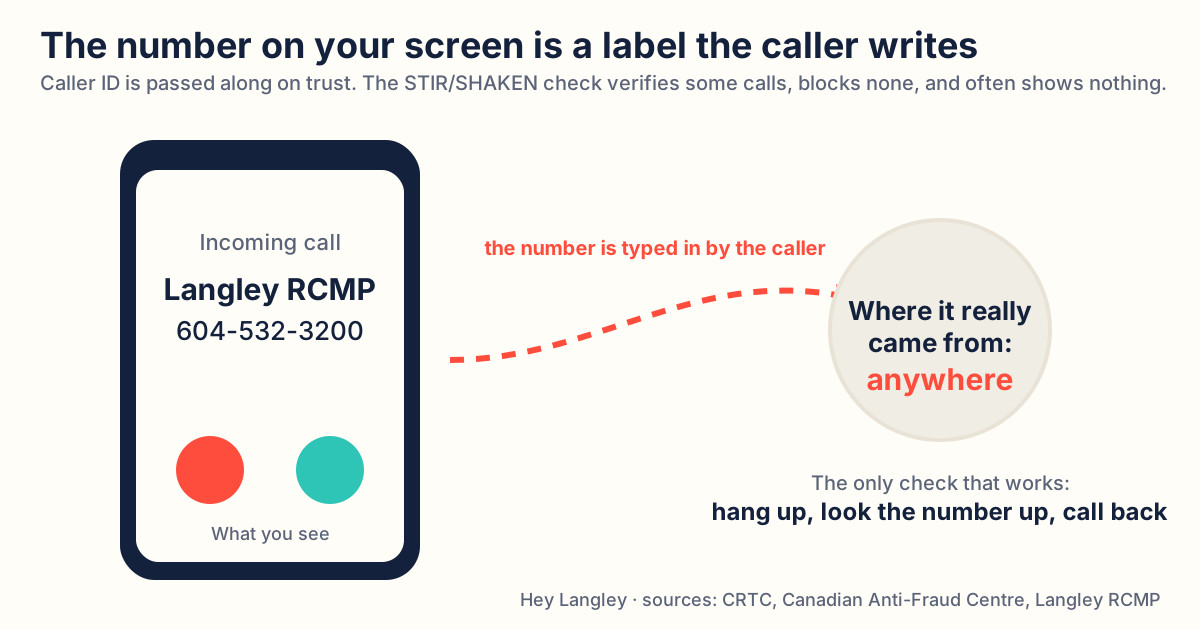
Picture a letter with “Langley RCMP” printed in the top corner, and the post office insisting that settles who wrote it. You’d laugh. Yet that is the deal we have had with the telephone for decades. The caller fills in the return address. The network passes it along. Your phone prints it in big friendly type, next to a photo if you’ve saved the contact, and your thumb does the rest.
This week the return address said 604-532-3200, the actual Langley detachment, on calls from people who are not the Langley detachment. Nobody broke into anything. Changing that field is about as hard as writing a different name on an envelope.
What makes it a rant rather than a shrug is that the fix exists, has a name, and has been officially in force since November 30, 2021. STIR/SHAKEN lets carriers digitally sign the number on a call so the receiving carrier can confirm the caller was entitled to use it. The CRTC first wanted it by September 2020. When it finally landed, the regulator’s own release carried the fine print: not all calls can be verified, and how the result is shown “may vary from one provider to another”. Five years on, the fine print is still the whole story. One big carrier’s help page explains that a missing “verified” label doesn’t mean a call is fake, that the system doesn’t block anything, and that it doesn’t apply on roaming or to app calls. So the honest reading of your screen is: this number might be real, or might not, and we may or may not tell you which.
Meanwhile the other side has no fine print. Canadians reported more than $704 million in fraud losses in 2025, and that’s only the people who reported.
To be fair to the regulator, it told a Commons committee in June that there’s no single solution and that it can’t touch the criminal end of this at all. True. But “no single solution” has quietly become “no finished solution”, and the people paying for the gap are the ones who still believe the screen.
What would fix it
Three things, none of them science fiction.
- Show the status on every call, in words. Not a tiny checkmark buried in the call history. “Verified” or “Not verified”, on the screen, while it’s ringing, on every network and every phone sold here. A label that only appears when the news is good is not a warning system.
- Treat an unverified call that claims a protected number as suspicious by default. If a call carries a police, bank or government number and the signature doesn’t check out, carriers already know enough to flag it. Say so on the screen. Let people opt out if they must.
- Publish the traceback numbers. The CRTC has had a process since 2019 for tracing nuisance calls to their origin. Tell us, once a year, how many were traced, how many originated inside Canadian networks, and what happened to those carriers. Sunlight does more than another pamphlet.
Until then, the only thing on your phone you can trust is the hang-up button. If you’ve been called, report it to the Langley RCMP and to the Anti-Fraud Centre at reportcyberandfraud.canada.ca. If you’d like the regulator to hear it, the CRTC takes complaints and questions through its contact line, 1-877-249-2782. Ask them when the fine print comes off.