What, no chickens? An open letter on backyard hens in the Township
Langley Township is farm country, yet you can't keep three hens behind a house in Willoughby. Surrey and Vancouver can. A modest, well-fenced ask for the new council: try a pilot.
This is an opinion piece, written as an open letter. Third in a short series to the new Township council; the others are on Brookswood’s trees and walking 36 Avenue.
To the Mayor and Council of the Township of Langley,
Here’s a small one, and a slightly funny one. The Township of Langley is farm country, and proud of it. And yet if you live on an ordinary house lot in Willoughby, Walnut Grove or Brookswood, you can’t keep three hens out back.
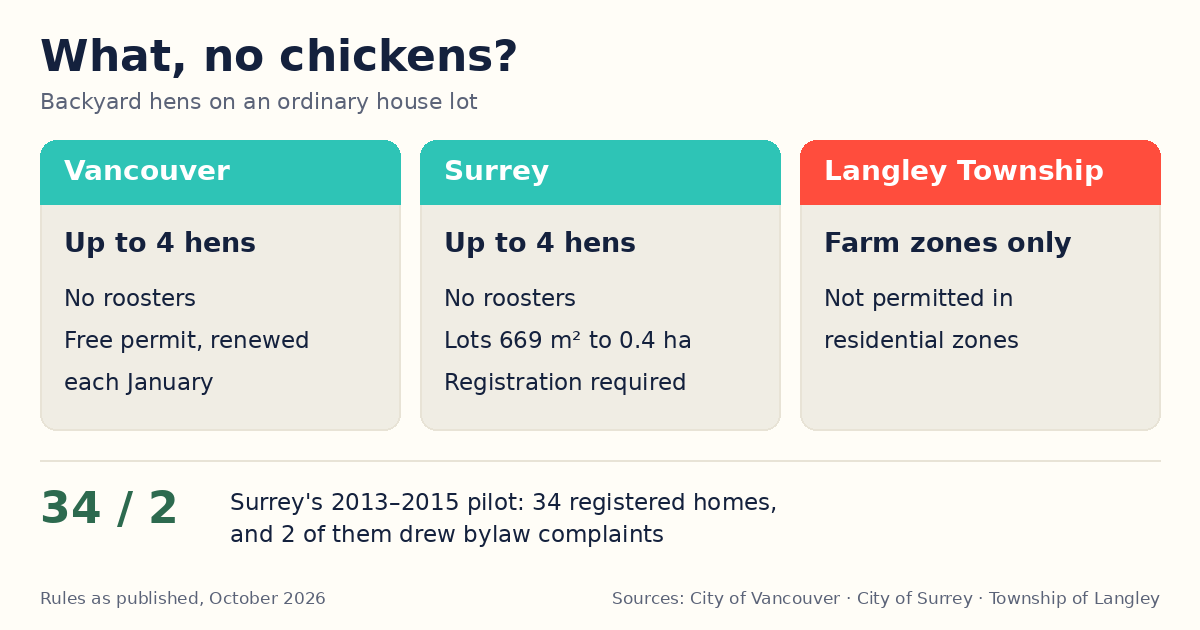
The Township’s animal control page is short and clear about it: keeping chickens “is permitted in agricultural zones only,” and chickens “are not permitted in residential zones.” Across the line in Surrey, and in the middle of Vancouver, you can.
We’d like the new council to try it here, carefully, as a pilot.
Next door already ran the experiment
Surrey started a backyard hen pilot in September 2013 and ran it for about two years. When staff reported back in 2016, 34 properties had registered, and only 2 of them had drawn a bylaw complaint. Staff were honest that not every coop got a formal inspection, so it isn’t a perfect study. But it was enough for Surrey to write proper rules, and those rules are still on the books:
- Up to four hens, no roosters.
- Only on certain residential lots, bigger than 669 square metres (about 7,200 square feet) and under 0.4 hectares.
- Register first. Tenants can register with the owner’s written permission.
- At least 0.37 square metres of coop floor and 0.92 square metres of outdoor run per hen.
- Feed kept in a sealed container and leftover feed cleared away.
- No selling eggs, meat or manure, and no backyard slaughter.
Vancouver’s rules are similar: four hens at most, four months or older, no roosters, and a free permit that you renew every January.
So nobody here would be inventing anything. It’s a well-worn path.
Why bother?
Not for cheap eggs. Anyone who has priced out a coop knows that’s not how the math works. The reasons are smaller and better than that:
- Kids learn where food comes from. Feeding, cleaning, checking for eggs every day. 4-H BC has a poultry project where young members raise a small flock. A backyard flock brings a version of that to kids in the suburbs.
- Kitchen scraps and garden. The BC SPCA notes chicken waste can be composted for the garden, with care.
- It fits who we are. A Township built on farming can let a family in a cul-de-sac keep a little of that too.
The worries are real, so put them in the rules
We’d be the first to say there are good reasons this needs care. They’re all fixable with rules.
Rats. Rats come for spilled feed. Surrey’s sealed-feed rule, a solid coop floor and quick cleanup belong in any Township version, alongside the Township’s own rodent advice about not leaving food out.
Bird flu. This matters most in Langley, and it is not hypothetical. The Canadian Food Inspection Agency estimates more than 10 million birds in BC have been affected since December 2021. As of its October 2026 update, BC had no infected farms, but that can change in a week. Poultry farmers in this valley know it well.
Update, Nov 7, 2026: it changed in a day. The CFIA’s detection list now shows avian influenza confirmed on Nov 6 in a commercial poultry flock in the City of Chilliwack, BC’s first detection of the season, with the control zone still “to be determined”. Before that, the province’s most recent cases were right here: a commercial flock and a backyard flock in Langley Township in February 2026. The CFIA’s advice to small-flock owners (keep wild birds away, don’t share equipment, report sick birds) applies now, not someday. So the pilot should be designed with them: run it past the Township’s Agricultural Advisory Committee and poultry vets, follow the CFIA’s small-flock rules (keep wild birds away from the flock, don’t share equipment, limit visitors, report sick birds), and have a clear switch for council to pause the pilot during an outbreak.
Tracing. BC already requires every poultry owner to register with the province’s free Premises ID program, so the province knows where birds are in an emergency. A Township permit could simply require proof of that number.
Kids and germs. The Public Health Agency of Canada says even healthy, clean birds often carry Salmonella, that children under five shouldn’t handle live poultry, and that everyone should wash their hands right after touching birds. Put that in the starter package.
The birds themselves. The SPCA says hens need company (keep at least two), a secure coop and run with room to scratch and dust-bathe, and proper poultry feed. They can live up to 10 years, but lay best in their first two. Every permit should come with a plan for the hen that stops laying.
Noise. That’s what the no-rooster rule is for. Hens cluck, but without a rooster there’s no dawn alarm.
The ask
A 12-month backyard hen pilot in the Township’s residential zones, with:
- Up to four hens per lot. No roosters, no breeding, no sales, no backyard slaughter.
- Registration, owner consent for renters, and a Premises ID number.
- Coop, run and feed-storage standards borrowed from Surrey’s bylaw.
- Design input from the Agricultural Advisory Committee and local poultry farmers, plus a pause button for bird flu.
- A public report at the end: how many households signed up, complaints, rats, animal-welfare problems, and what it cost staff to run.
If the numbers are bad, end it. If they look like Surrey’s, write the bylaw.
For everyone else reading
- Email council at [email protected], with your neighbourhood and why you’d sign up, or why you wouldn’t.
- Want to say it in person? Our council meetings page explains how to ask for a delegation spot.
- City of Langley residents: this letter is about the Township. The City has its own rules.
Warmly (and with an empty egg carton),
Hey Langley
More: Township council: who they are · City vs. Township · Langley farm stands open into winter