- Where
- Fort Langley Cemetery, 23105 St. Andrews Avenue at Glover Road, Fort Langley (Township of Langley)
- Gates
- Open daily, 8am to dusk (Township cemeteries page)
- The walk
- Eight stops; the graves on it sit within about 150 metres of each other. Allow 45 minutes to an hour if you stop to read
- Find any grave
- Township burial records on Open Data (name, plot reference and a map point)
- Cost
- Free
- Cemetery office
- 4393 208 Street, Monday to Friday 8:30am to 4pm; 604-534-5965, [email protected]
- Last checked
- November 7, 2026
The Township’s burial records for Fort Langley Cemetery are public, and every record carries a plot reference and a map point. That turns a wander among old stones into something you can plan: pick a name, drop a pin, walk to it. This page does that for eight stops whose stories are documented by the Langley Centennial Museum, the Langley Heritage Society and Veterans Affairs Canada.
It’s a companion to our main Fort Langley Cemetery page, which covers the cemetery’s history, plots and fees. Here we’re just walking.
Before you go
The cemetery is still in use. If a funeral or a family is at a graveside, take a different row and come back later.
Decorations are the families’ business: the Township’s Cemetery Bylaw (section 18) only allows cut flowers, wreaths and artificial flowers on a lot, so leave things as you find them. Old marble is soft and some of these stones are 140 years old; look, photograph, but don’t lean on them or rub them.
How the plot references work. The Township lists each grave by Range (a letter), then Block, Plot and Grave numbers. We give the Range and Block below, and a map link built from the Township’s coordinates. The points get you to the right patch of grass; you may need to read a few stones either side.
The route
Start at the cenotaph in the northeast corner and work south toward St. Andrews Avenue.
1. The cenotaph and the veterans’ section
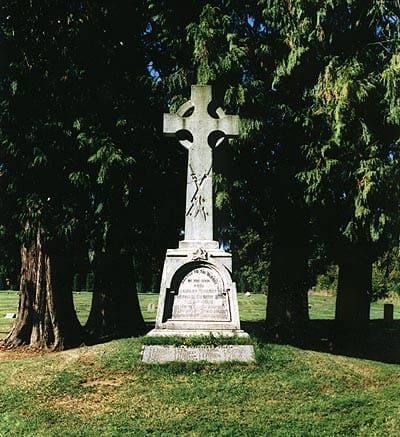
The granite Celtic cross stands on a small knoll among tall cedars, at the northeast corner of the cemetery. The Langley Heritage Society’s remembrance panel says residents paid for it, with returned soldiers Dr. Benjamin Marr and municipal clerk Archie Payne leading the effort, and that it was unveiled in April 1920 by two small boys, Alf and William Trattle, whose father had been killed in the war. A First World War gun stood beside it in the early 1920s. The Heritage Society says the Celtic cross at the Murrayville cemetery is a duplicate of this one.
The cenotaph remembers men who never came home. Veterans Affairs Canada’s Canadian Virtual War Memorial links four of them to this cenotaph, and their graves are in France and Belgium:
- Private Montague Wix, 16th Battalion, killed July 19, 1916, aged 18; buried at Larch Wood (Railway Cutting) Cemetery.
- Lieutenant Robert Simonds, Princess Patricia’s Canadian Light Infantry, killed April 9, 1917, aged 20; a Murrayville native, buried at La Chaudière Military Cemetery.
- Lance Corporal Hew McKenzie Bradshaw, British Columbia Regiment, killed September 2, 1918, aged 19; his parents lived in Langley Prairie. Buried at Wancourt British Cemetery.
- Sergeant John Crowell Henderson, 47th Battalion, killed September 28, 1918, aged 31; buried at Bourlon Wood Cemetery.
Behind the cedars is the veterans’ section. The museum says it existed before 1924, and the Heritage Society panel says burial areas for veterans were set aside in both Township cemeteries after the 1920 cenotaphs went up. In From the West Coast to the Western Front, Mark Forsythe and Greg Dickson write that many graves here belong to men who came home and died of their wounds not long after, and that small Canadian flags mark the plots each year.
Look back at the road as you leave. The same book says the 18 chestnut trees along the cemetery fence on Glover Road were planted for local men who didn’t come back.
2. The Marr family (Range G, Block 9)
The burial records list Benjamin Butler Marr, born 1882, with his family in Range G, Block 9 (map). The Heritage Society’s walking tour credits a Dr. Marr with pushing for the cenotaph you’ve just left; check the record if you’re looking for the doctor himself. The tour also marks the Dr. Marr Residence as one of the village’s heritage houses.
3. The Allards (Range D, Block 8)
A cluster of Allard graves sits in Range D, Block 8 (map). The Heritage Society notes that Allard is one of the names here that go back to the Hudson’s Bay Company fort. Forsythe and Dickson tell the family’s First World War story: William “Billy” Allard fought at the Somme, Vimy and Passchendaele and came home to a long life; his brother Eugene was killed at Passchendaele, and Allard Crescent is named for him. Another brother died six years after being gassed. For the fur-trade side of the family, see our page on Ovid Allard.
4. Susannah Yeomans’ metal marker (Range C, Block 9)
A few steps east, in Range C, Block 9 (map), is the oddity of the walk. The museum describes Susannah Yeomans’ marker as cast metal coated with zinc to stop rust, with fine leafy decoration. Markers like it turn up in Victoria, but the museum says this is the only one in Langley.
5. The Mavis family (Range B, Blocks 16 and 17)
Next door, in Range B (map), the museum’s example of an early-1900s stone: a polished red granite obelisk naming several family members on one monument, a fashion that replaced the single Victorian tablet. The records list an Alexander Mavis, born 1825. The museum notes that an Alexander Mavis bought the old fort land, pioneer burial ground included, after the fort closed in 1886, and sold it to the Anglicans who built St. George’s in 1901.
6. The West family monument (Range D, Block 3)
Head southwest to the biggest monument in the cemetery (map). The records place Henry West, born 1835, and Louisa West in Range D, Block 3. The museum calls the West monument the largest and most impressive here: white marble climbing in tiers to a Gothic canopy on four columns over an urn. Henry West arrived in the early 1870s and ran a steam sawmill east of the village.
7. Julia Robertson (Range B, Block 7)
A short way south (map) is the stone the museum singles out for its symbols: a hand, read as the hand of God, carrying flowers that stand for the soul. Julia Robertson was the First Nations wife of Samuel Robertson; the couple ran the What Cheer House saloon at Derby and a saloon company in Fort Langley. She was living in Maple Ridge when she died, but Maple Ridge had no cemetery yet, so she was brought here.
8. Robert Mackie, the first burial (Range B, Block 1)
End at the south edge, near St. Andrews Avenue (map). The museum names Robert Mackie as the cemetery’s first burial, in 1882, and uses his stone to explain Victorian design: the inscription set on a raised shield to look old and heraldic, with carved drapery on each side for mourning. Other Mackies share the block.
Right beside it, in Range A, Block 3, are Kenneth and Lucy Morrison. Morrison is the other family name the Heritage Society traces back to fur-trade days.
Why two founding dates?
You’ll see 1881 and 1884. The museum says the cemetery was established in 1881, when the rules required burial grounds to be kept away from where people lived; the Heritage Society’s walking tour gives 1884. The village has long since grown around it. One early burial didn’t stay: Alexander Murray, drowned in the Fraser in January 1884, was first buried here, then moved by his family to the new Odd Fellows cemetery in Murrayville.
Keep walking
St. Andrew’s United Church, which the Heritage Society dates to 1885, is next door. A few blocks north, the Hudson’s Bay Company Pioneer Cemetery beside St. George’s holds the fort-era burials that came before this cemetery. The Fort Langley village guide has the rest of the village, and our Langley cemeteries page covers all of them.
On November 11, the Fort Langley Remembrance Day service is held at this cenotaph at about 10:30am, and Glover Road closes at 9:45am, according to Fort Langley Remembers. Times for every ceremony are on our Remembrance Day in Langley page.
Something out of date? Tell us.
Last checked November 6, 2026. Spotted something out of date? Tell us.
