- See one inside a park
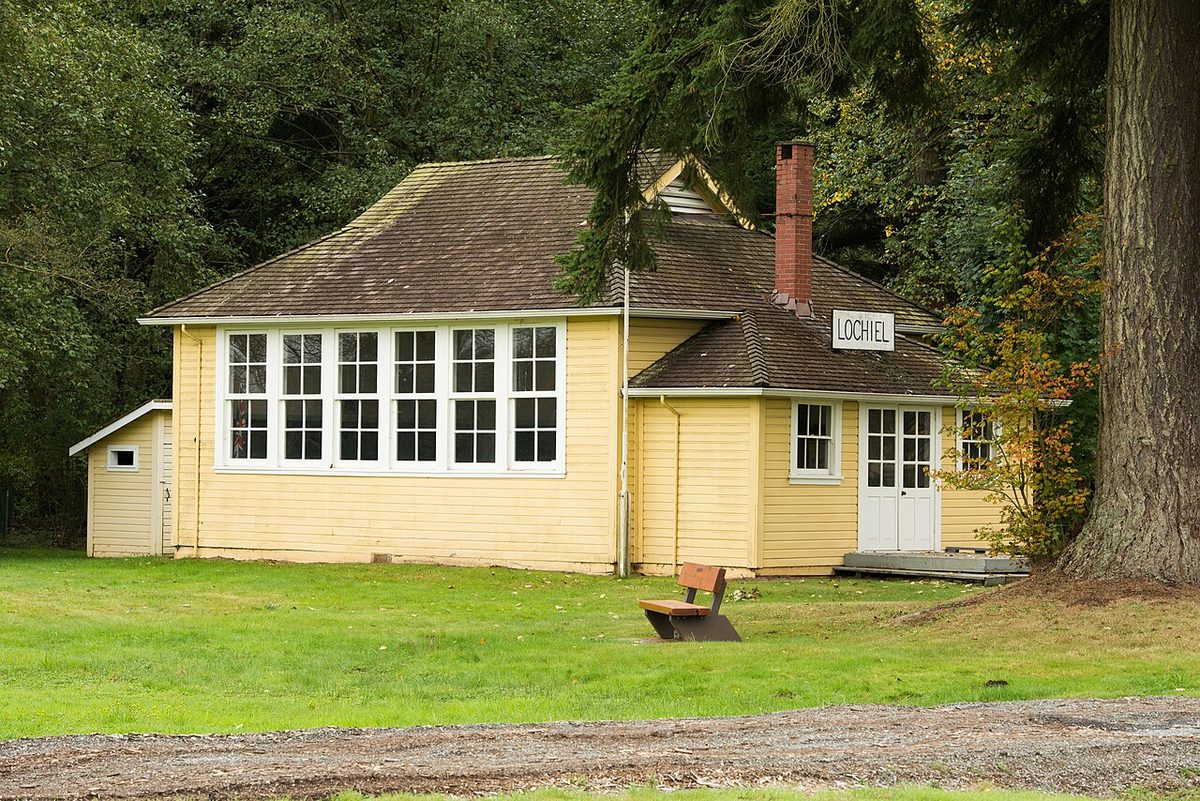
- Lochiel Schoolhouse (1924), Campbell Valley Regional Park, near the 8 Avenue (South Valley) entrance; grounds open daily, park hours Nov 3 to Dec 31 are 7 am to 6 pm (Metro Vancouver)
- See one from the street
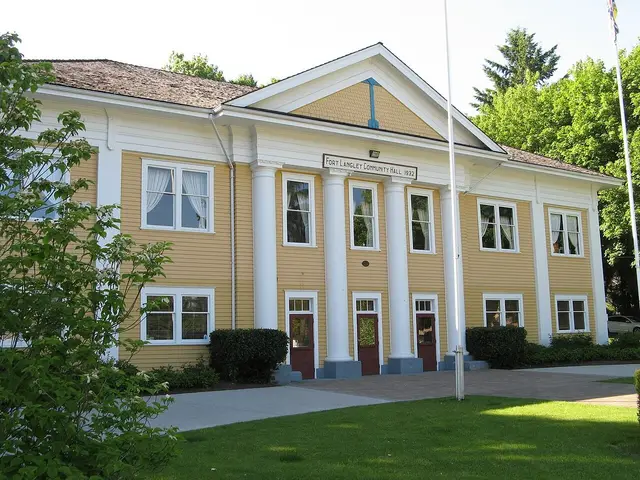
- The 1931 Willoughby school, on the Willoughby Elementary grounds facing 208 Street; a working school site, so look from the sidewalk
- How many
- 15 small schools were folded into the new Langley School District in 1906–07
- Main record
- History of Langley Schools, Langley Retired Teachers' Association (2004)
- Last checked
- November 20, 2026
At Douglas School, a log schoolhouse at the corner of what is now 272 Street and 48 Avenue, one of the pupils was paid a dollar to sweep the floor, tend the stove and split the wood. That was the job description of a Langley school in 1895: one room, 20 by 34 feet, a single teacher with every grade, and a building that doubled as the church and the dance hall on weekends.
Langley had dozens of these. Most are gone, a few became houses or halls, and two are still standing where you can go and look at them: the Lochiel Schoolhouse in Campbell Valley Regional Park and the 1931 Willoughby school on 208 Street. Canada’s Historic Places calls Lochiel “one of two surviving examples of its type in Langley.”
Where Langley’s one-room schools stood
Locations are given by road, the way the old records give them, with the old road names in brackets where they help. Opening and closing years come from the Langley Retired Teachers’ Association’s History of Langley Schools, which has a page for each school.
| School | Years | Where it stood | What happened next |
|---|---|---|---|
| Langley School, Derby | 1867–1868 | Derby, west of today’s Fort Langley, in an empty colonial government building | Moved to a new school on Mavis Street in Fort Langley in 1868 |
| Prairie School No. 1 | Opened 1875 | Northwest corner of Glover Road and Yale Road, at Innes Corners | That corner is now in downtown Langley City |
| Glen Valley | 1885–1935 | Jackman Road (272 St), a little north of 88 Avenue; a new one-room school replaced it in 1924 | Closed in 1935; pupils bused to Fort Langley and Langley High |
| Aldergrove | 1887; new school 1888 | First in a split-cedar hall at Jackman and Yale roads, then on Yale Road between Jackman Road and Shortreed Corners (264 St) | A two-room school went up in 1913 on today’s Aldergrove Elementary site |
| Otter | 1889 | South side of Yale Road, midway between Livingstone Road (232 St) and Brown Road (240 St) | The name carries on at Otter Elementary |
| Lochiel (first called Biggar’s Prairie) | 1889; rebuilt 1924 | North Bluff Road (16 Ave) | The 1924 building is now in Campbell Valley Regional Park |
| Belmont No. 1 | 1891–1910 | On the hillside south of Murray’s Corners, on Townline Road (216 St) | Sold in 1910; replaced by Belmont Superior (now Murrayville Elementary) on the hill on Yale Road |
| Glenwood | 1891 | Southwest corner of North Bluff Road (16 Ave) and Johnson-Townline (216 St) | A one-room school with a basement replaced it in 1916; a two-room school opened at 24 Avenue and 208 Street in 1945 |
| Patricia (first called Aldergrove South) | 1891 | Near 264 Street and 8 Avenue, on the northeast side | Renamed Patricia in 1912; a two-room school by the 1960s |
| Beaver | 1893–1918 | Coghlan Road (256 St) at Roberts Road (56 Ave) | Closed when County Line opened; sold to the Presbyterian church in 1921, later demolished |
| Douglas | 1895–1918 | Jackman Road (272 St) at Watson Trail (48 Ave), a log building | Closed when County Line opened |
| Springbrook | 1896–1931 | Balfour Road (232 St) at Springbrook Road (72 Ave) | Bought in 1934 by the Harmsworth Social Improvement Society and renamed Harmsworth Community Hall |
| West Langley | 1914 | 208 Street and 96 Avenue | Kept growing; burned in 1978; a Langley fire hall now stands on the site |
| Willoughby | Early 1920s; new school 1931 | First in the community hall on 208 Street, then a two-storey building on the school grounds facing 208 Street | The 1931 building is still on the Willoughby Elementary grounds |
| South Otter | 1922–1983 | Warner Road (8 Ave) at Otter Road (248 St) | Closed in 1983 |
| Sperling | 1923–early 1980s | 240 Street, in the Sperling area | Sold in 1985; now privately owned |
A few of these old buildings were later sold and turned into houses. They are private homes now and not open to visitors.
The Lochiel Schoolhouse in Campbell Valley Park
The first school here opened in 1889 as Biggar’s Prairie School, on land the Biggar family gave. The name changed after a falling-out between two pioneer families: the Camerons, who won, named it after the chief of their Scottish clan, according to Canada’s Historic Places. In 1891 the Columbian newspaper reported the end-of-year exams and picnic, complete with bagpipes, stone throwing, food and dancing late into the day.
The building you see now went up in 1924 as a replacement. It had a rough start. After a single year the district decided to bus the children to Murrayville instead, and the school sat empty until 1941–42, when it reopened with about 40 pupils in grades 1 to 6. In 1950 it was moved to a three-acre lot on 224 Street just south of 16 Avenue, and additions and portables grew up around it.
Then in 1975 arsonists set fire to the school. The old room survived the smoke and water, was moved off the property, and sat idle for about a decade. A former teacher from the 1940s drove past it in 1987, and her push got the Langley Heritage Society interested. Metro Vancouver says it was moved into Campbell Valley Regional Park in 1988 and restored, next to the Annand/Rowlatt farmstead, a designated heritage site with buildings going back to 1898.
What to look for: the cloakroom across the front with its coat hooks, the double wooden front doors, a tall narrow chimney in the middle of the front, the wall of six tall windows down one side and a row of high clerestory windows on the other. The Township’s Langley Centennial Museum uses it for programs that take school classes back to 1924.
How to visit: use the South Valley entrance on 8 Avenue (parking, washrooms and the picnic area are there) and walk up to the farmstead and schoolhouse. You can walk around the outside whenever the park is open; the inside opens for the museum’s programs. See our Campbell Valley Regional Park guide for trails and hours.
The 1931 Willoughby school on 208 Street
Willoughby got its first classes in the early 1920s, when settlers built a hall on 208 Street to hold them. They raised the money with Saturday night dances in each other’s homes, carrying a portable gramophone from house to house, and John Bray gave the land. One teacher took grades 1 to 8, with 20 to 30 children at a time.
The two-storey school came about by accident. When County Line School burned down in 1931, the district struck a deal with the contractors to rebuild County Line and put up a new school at Willoughby too, and the $5,000 insurance payout covered both. The result follows a typical Langley pattern of the 1930s: the classroom upstairs, raised about seven feet over a short ground floor used as a play area. Canada’s Historic Places describes it as “a 2 storey building in a 1 storey town.”
It survived a big fire on November 27, 1975, which destroyed most of the newer annex while the wind pushed the flames away from the old building. It was heritage-designated in 1994, after what the heritage record calls a long and heated debate over keeping its form and use, and it is recognised as the last two-storey, one-room school still in regular use in the Langley School District.
How to see it: the building faces 208 Street on the Willoughby Elementary grounds, a few blocks from the 1937 Willoughby Community Hall, which replaced the first hall-school (more in our Willoughby guide). It’s a working school site, so look from the sidewalk, and not at drop-off or pickup time. Worth knowing: in February 2026 the Township, the Province and the school district signed an agreement to study moving Willoughby Elementary to a new school next to the Langley Tennis Centre in Yorkson Community Park and turning the current site into a community centre. A feasibility study comes next.
How the one-room era ended
The province’s Public Schools Act of 1872 let any community with at least fifteen children between 5 and 15 form its own school district, with its own board of trustees and government grants for a building and a teacher. That is why the map filled up with tiny schools, often a few kilometres apart. Teachers earned $40 to $100 a month depending on attendance, and some schools only survived because a family sent along a four- or five-year-old to keep the numbers up, as happened at Springbrook in 1903 and West Langley.
In 1906–07 the 15 separate boards were merged into one Langley School District: Belmont, Aldergrove, Glen Valley, South Aldergrove (Patricia), Langley Prairie, Port Kells, Lochiel, Beaver, Langley, Otter, Springbrook, Glencoe, Douglas, East Langley and Glenwood. After that, the small schools closed one by one as bigger schools opened and buses arrived. County Line took over from Beaver and Douglas in 1918. Springbrook’s children went by a homemade school bus to Fort Langley from 1931. Glen Valley closed in 1935. South Otter closed in 1983, and Sperling in the early 1980s.
For the bigger picture, see the history of Langley, our list of heritage buildings you can actually walk into, and the Langley Centennial Museum, which runs the Lochiel school programs.
Last checked November 19, 2026. Spotted something out of date? Tell us.