- Langley City: how to ask
- A petition on the City's form, signed by 50% of residents in the area (or 10, whichever is lower)
- Langley City: contact
- Engineering Services, 20399 Douglas Crescent, 604-514-2997
- Township: how to ask
- A written request to Engineering: [email protected], 604-533-6006, or the counter at 20338 65 Avenue
- Support needed
- City: 50% of residents back the plan. Township: 60% of returned ballots
- Never on
- Arterial roads (no speed humps in either municipality)
- Policies
- City CO-47 · Township 05-110
- Last checked
- November 16, 2026
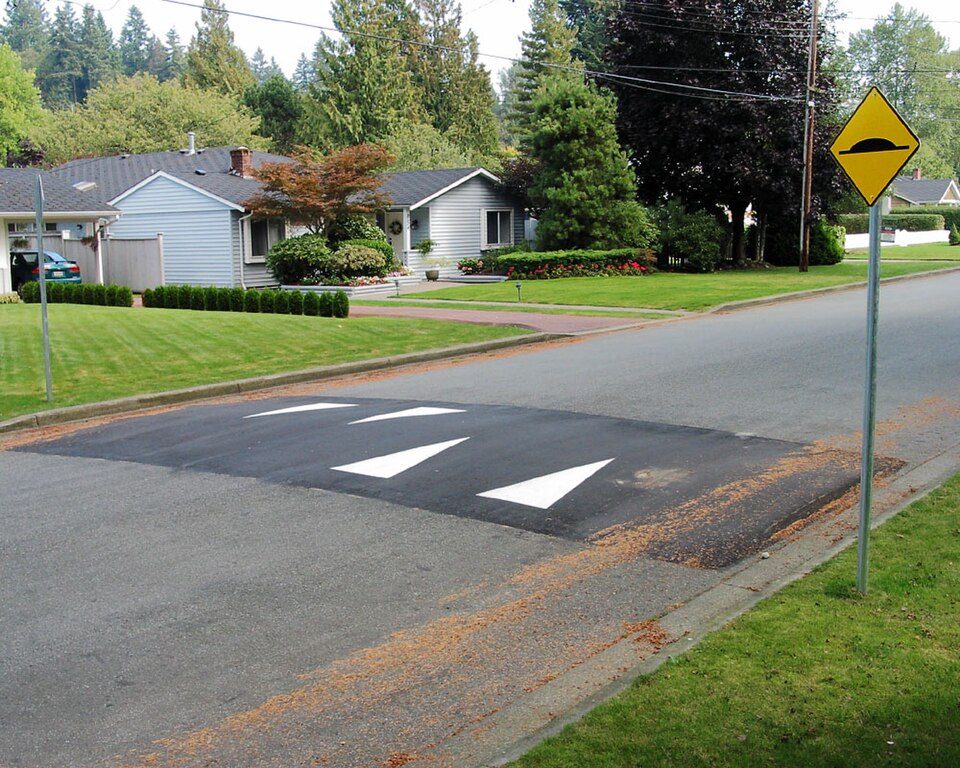
To get a speed hump in Langley, you ask your own municipality, and the two do it differently. Langley City wants a signed petition from your neighbours before it will even measure traffic. The Township takes a request from one person, by email, phone or at the counter, then puts it on a list it reviews once a year. Both check that most of the neighbourhood supports the plan, and neither builds anything until the money is in the budget.
Not sure which one you live in? Check our City vs Township guide first.
The ground rules in both
- Arterials are out. Neither municipality puts speed humps or raised crossings on arterial roads. The Township may still consider “horizontal” measures there, like curb extensions or chicanes, and low-impact options.
- Collectors are limited. The City allows speed humps and raised crosswalks on collectors only in front of elementary schools and parks. The Township has a table of which devices it will consider on each type of road.
- Local streets and lanes are where most traffic calming happens, at the engineer’s discretion.
- A few speeders isn’t enough. The City’s policy says traffic calming is for streets where most drivers go too fast. If it’s just a handful, the City points to RCMP enforcement instead. It also notes each speed hump adds about 10 seconds to a fire truck’s or ambulance’s response time.
Langley City, step by step
- Get the petition. It’s attached to the end of Policy CO-47. Write down the street and the blocks you’re asking about.
- Collect signatures. You need at least 50% of the residents in the “benefitting area” (at least one block, set by the City Engineer), or 10 residents if that’s fewer. Only one signature counts per household.
- Hand it in. Mail or drop off the signed original at City of Langley Engineering Services, 20399 Douglas Crescent, Langley V3A 4B3 (604-514-2997).
- The City counts traffic. Staff measure speeds and volumes and check the road type and crash history. The surveys usually happen in fall or spring, when school is in and the weather cooperates. If the street doesn’t meet the minimum, the City tells residents and the request stops there.
- Neighbours approve a plan. If calming is warranted, the City drafts a plan and contacts residents by email or phone. At least 50% of residents in the area must support it.
- It gets ranked. Anything within 150 m of a school or playground goes first. Every other street is scored out of 100 points:
- speed, up to 40 points (how far the 85th-percentile speed is over the limit)
- no sidewalk, 20
- a bike route with no separated lane, 20
- traffic volume, up to 10 (for example, a local street over 750 vehicles a day)
- more than one preventable crash a year for five years, 10
- Council is told, and it waits for funding. Staff report the supported plan and its priority to council. When it’s built depends on that priority and the budget.
The City is also working on a wider slow-streets program. In April 2026, council asked staff to put a capital item for one in the 2027 budget (what council decided).
Township of Langley, step by step
- Send a written request to the Engineering Division, by email to [email protected], at the Engineering counter at 20338 65 Avenue, or by calling 604-533-6006. Say exactly where, and what you’re seeing.
- It goes on the list. Requests are taken all year and added to the traffic calming request list.
- Annual review. Once a year the Township assesses the list against Policy 05-110. It looks at road type, traffic volume, short-cutting, the 85th-percentile speed, ICBC crash history, pedestrians, land use, nearby schools and parks, cycling and transit routes, sidewalks, and whether traffic would just shift to the next street.
- Budget approval. Priority locations need money in the annual capital budget. Council set aside $200,000 for traffic calming in 2026 (March 9 budget decisions).
- Ballot. The Township drafts a plan and sends ballots to affected property owners. At least 60% of the ballots returned must be in favour. Streets in front of schools or in playground zones skip the ballot, and council can order traffic calming on its own.
- Build. After any changes from the ballot, the Township notifies council, and construction can start.
The Township’s recent projects are mostly in front of schools. Examples include 32 Avenue at Parkside Elementary in Aldergrove, Trattle Street at Langley Fine Arts in Fort Langley, and 83 Avenue at Lynn Fripps Elementary in Willoughby. Council also endorsed a Walnut Grove Drive plan in May 2026 (what council decided).
How long does it take?
Neither policy gives a deadline. In the City, the traffic count waits for the next spring or fall survey. In the Township, a request waits for the annual review. In both, building it depends on where your street ranks and how much budget there is.
If the answer is no
The Township points to its “3 E’s”: education, enforcement and engineering. You can volunteer with Speed Watch, ICBC’s roadside speed-awareness program, by emailing the Langley RCMP at [email protected]. To ask for enforcement on a street, call the Langley RCMP non-emergency line at 604-532-3200. For a broken sign, a faded crosswalk or another fix, use report a problem. To raise it with council, see how to speak at a council meeting.
Something out of date? Tell us.
Last checked November 15, 2026. Spotted something out of date? Tell us.