Langley's airport is getting ready for air taxis. Here's what's real and what's still years off
Langley Regional Airport has set aside 14 acres and commissioned a vertiport design for electric air taxis. What a vertiport is, what the aircraft are, who might fly them in B.C., and why nobody is booking a seat yet.
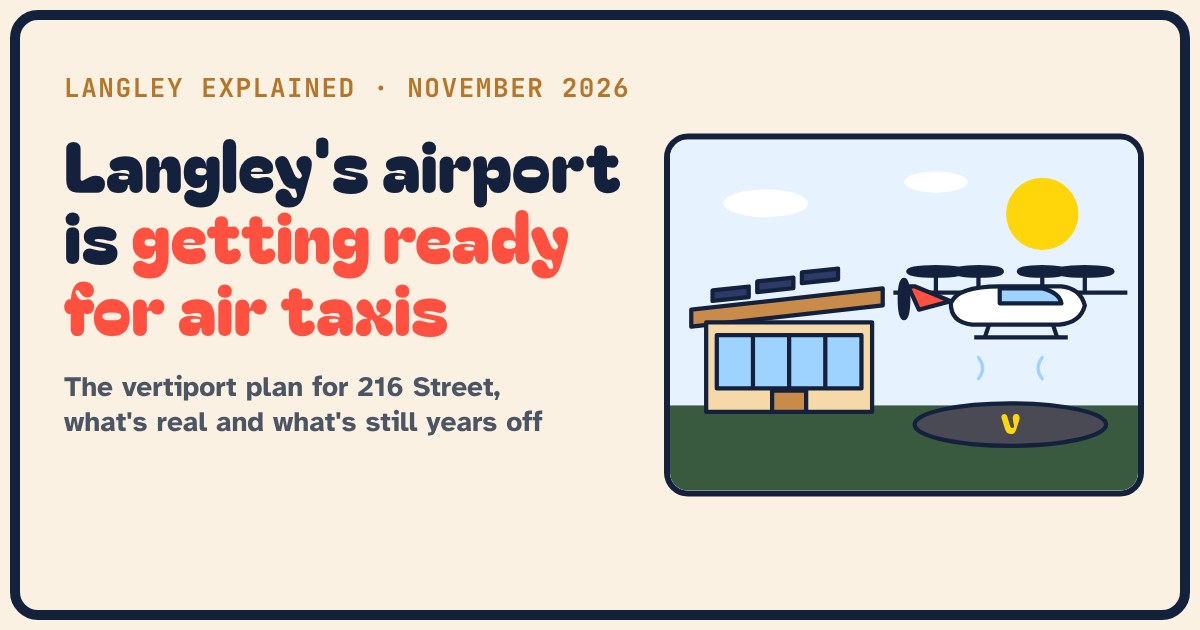
When we asked Langley Regional Airport for its 2025 numbers, the airport slipped one more thing into its reply. It wants to be one of the places in Canada where a whole new kind of aircraft lands first: small, quiet, electric “air taxis” that take off straight up.
That sounded like something out of a movie, so we dug in. Here’s what the plan actually is, what these aircraft are, who might fly them around B.C., and the honest answer to the question everybody asks next: when can I ride one?
Where things stand: as of November 2026. This is a fast-moving industry, so we’ll update this page as the airport’s plans and the aircraft move along.
First, what is an “air taxi”?
The industry calls them eVTOLs: electric vertical takeoff and landing aircraft. Picture something between a helicopter and a small plane. Most designs have several small rotors that lift them straight up like a helicopter, then wings (and often a rear propeller) that carry them forward like a plane once they’re moving.
The pitch is simple:
- Quieter than a helicopter, because small electric rotors don’t make the same racket as one big rotor and a turbine engine.
- No fuel burned in flight, since they run on batteries.
- Short hops, usually carrying a pilot and four or five passengers, or cargo.
The umbrella term for all of this, including drones, cargo flights and the ground infrastructure that goes with them, is Advanced Air Mobility, or AAM. Transport Canada describes it as two things: moving people and goods by air within cities, and connecting smaller and remote communities across a region.
And what’s a vertiport?
It’s an airport for air taxis. At minimum that means a landing pad, chargers and somewhere for passengers to wait. Because eVTOLs take off and land vertically, a vertiport can be far smaller than a runway. They can go on rooftops, at hospitals, at heliports, or tucked into a corner of an existing airport.
That last option is the one Langley is going for.
What Langley’s airport is actually planning
This isn’t a vague “someday.” There are real steps on paper:
14 acres set aside. The airport’s 20-year strategic plan reserves 14 acres on the west side of the field for advanced air mobility. The plan was shaped with tenants and the public. At the March 2025 open houses, the “emerging technologies” area was described as space for new takeoff and landing zones such as vertiports, maintenance for AAM aircraft, charging, air traffic management systems, and research and training.
A feasibility study. The airport says it produced Canada’s first Advanced Air Mobility feasibility study, working through how air taxis would fit into a busy general aviation airport. At a B.C. Aviation Council conference in Kelowna in May 2026, the airport said it’s studying what AAM will mean for urban air taxi service across the Lower Mainland, with real use cases and an early business case. The industry conversation, it said, is no longer about if these aircraft arrive but how they’ll fit into everyday airfield operations.
A real design. In July 2026, the Vancouver studio of architecture firm Perkins&Will and the national industry group Canadian Advanced Air Mobility (CAAM) unveiled a vertiport concept designed for Langley Regional Airport.
The vertiport design, in plain English
You can see the renderings on Perkins&Will’s project page and CAAM’s announcement, and they’re worth a look. In short:
- Built from familiar stuff. Modular, prefabricated pieces that can be added to as demand grows, with a mass timber structure and finishes. Think of a warm, wood-heavy, West Coast building rather than a chrome sci-fi pod.
- A passenger lounge with big windows onto the airfield, seating and a coffee counter. The renderings show solar panels on the roof.
- A landside business campus next to it, meant to bring in commercial activity and jobs alongside the flights.
- Built in phases. Each stage is tied to how fast the aircraft get certified, how the regulations land and how many people actually want to fly. The design doesn’t come with dates, costs or a size.
- A design meant to travel. The compact layout is meant to work at airports, transit hubs and rural or remote sites too, so Langley could be one stop in a larger B.C. network.
It’s a concept, not a building permit. Nothing is under construction and no budget has been announced. What the concept gives the airport is a roadmap it can fold into its long-term capital planning.
Who would actually fly them in B.C.?
The most advanced B.C. player is Helijet, the Vancouver helicopter airline that flies between Vancouver, Victoria and Nanaimo. In late 2023, with Premier David Eby on hand, Helijet placed what it called the first firm order by a Canadian air carrier for eVTOLs: four Alia aircraft from Vermont-based Beta Technologies, with options on four more. The Alia carries a pilot and five passengers. Helijet has said it wants to link its existing helicopter routes to a network of vertiports, and it’s leading work on a vertiport at its downtown Vancouver waterfront heliport.
In November 2025, Beta flew its runway-based electric plane, the Alia CX300, into YVR on a demonstration visit hosted by Helijet and CAAM. Langley Regional Airport staff were there and got a firsthand look at how quiet it is.
Nobody has announced a Langley route. The airport’s pitch is that it can be a regional hub: an existing, well-equipped airfield in one of B.C.'s fastest-growing municipalities, with room to grow. When air taxis do arrive, routes like Langley to downtown Vancouver, YVR, Victoria or the Fraser Valley are the obvious ideas people float. Those are ideas, not plans.
So when can I ride one?
Honest answer: not yet, and probably not for a few years.
- No air taxi is certified to carry paying passengers in Canada or the U.S. as of November 2026. Certification is the long, expensive process where regulators sign off that a new aircraft design is safe.
- In the U.S., where most of the leading companies are, the timelines keep slipping. In November 2026, Joby and Archer, two of the best-known developers, both pushed their first passenger flights into 2027. Joby is in the final stage of FAA certification. Archer is further back.
- Beta, the maker of Helijet’s aircraft, says its Alia eVTOL will be the first to earn FAA certification but hasn’t put a date on it. The company is selling its conventional runway version first, mainly for cargo and medical flights.
- In Canada, Transport Canada is working through how to approve and regulate these aircraft. Canadian service will largely follow how quickly designs are certified and approved here.
Earlier targets, 2026 included, have come and gone. Treat any date with healthy skepticism.
The case for, and the questions
Why the airport thinks it’s worth getting ready now:
- Vertiports take years to plan and build, so airports that wait for the first certified aircraft will be late.
- Quieter, battery-powered aircraft could eventually replace some helicopter noise and fuel burn at an airport where most businesses are helicopter-focused.
- The airport sees jobs, new business on the landside campus, and better links for a fast-growing community. It also points to uses beyond passengers: medical transport, cargo and emergency response.
What people will reasonably ask:
- Noise. “Quieter than a helicopter” still isn’t silent. How these aircraft sound over neighbourhoods near 216 Street, at real traffic levels, is something residents will want to hear more about.
- Cost. Nobody has said what a ride would cost, or who would pay for the vertiport itself.
- Batteries and weather. Range, charging time and how the aircraft cope with a Fraser Valley winter are still being proven.
- Timing. It’s a plan built on aircraft that don’t have their paperwork yet. The airport’s phased approach is designed around exactly that uncertainty.
What to watch for
- Certification news from Beta, Joby and Archer in 2027. The first FAA approvals will set the pace for everything else.
- Helijet’s next steps in B.C., including its downtown Vancouver vertiport.
- Langley Regional Airport’s planning, including any next phase for the west side lands. We’ll be asking again.
Want to see the airport where all this might happen? Start with our Langley Regional Airport page, visit the Canadian Museum of Flight on the same field, and read Langley Regional Airport by the numbers for the 2025 traffic figures and the airport’s best stories.
Got a Langley question you’ve always wondered about? Email [email protected] and we might go and ask for you.