Nearly 900 plants, one school, one wet morning: Murrayville's new mini forest
James Hill Elementary students, Township crews, LEPS and volunteers planted nearly 900 native trees, shrubs and groundcover at James Hill Park, the Township's biggest Miyawaki-style mini forest yet.
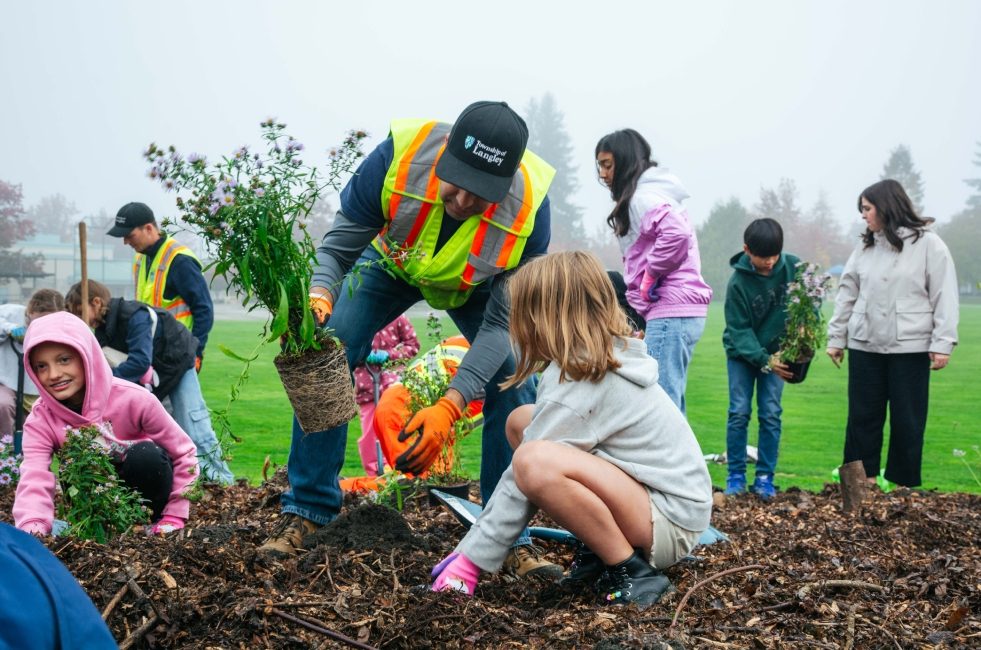
The corner of James Hill Park that lost its trees now has 900 small ones. In the last week of October, students from James Hill Elementary, Township of Langley parks staff, Langley Environmental Partners Society (LEPS) and a crowd of volunteers put nearly 900 native trees, shrubs and groundcover plants into a prepared bed at the park on Old Yale Road at 222 Street, beside the school. The Township’s release calls it its largest mini forest project to date.
Why that spot
The park was once part of a bigger stand of forest. When the land around it was developed, only a thin strip of trees was left, and a strip of trees has no windbreak. Storms kept taking them down, the failures became a safety problem, and most of what remained was removed. The Township’s Trees crew lead on the project, Dan Pulsifer, says the site came to mind “right away” when he finished a mini-forest training course about a year ago: a place that had a forest and lost it.
What followed was a year of coordinating with LEPS and the school, bringing in soil and preparing the ground before a single plant went in.
What a “mini forest” is
The Township calls it the Miyawaki method. Instead of spacing out a few trees on a lawn, you pack a diverse mix of native species in tightly, with the soil built up first. The plants compete for light, grow faster and taller than they would alone, and within a few years the patch starts to behave like a real forest floor rather than a planting bed. The Township’s stated goal is wildlife habitat, more biodiversity and a bigger urban canopy over time; Pulsifer’s own benchmark is what it looks like in 20 to 30 years.
This is the Township’s third one. LEPS and Township parks staff planted the first, about 300 plants on a weedy roadside berm at the Derek Doubleday Arboretum, in 2023, with more than 50 volunteers finishing the planting in under two hours after weeks of hand-digging to fix the compacted soil. The second, 330 plants, went into Gloucester Park in 2025. James Hill is nearly three times the size of either.
Who paid
Grants to the Township and to LEPS from two sources: Growing Canada’s Community Canopies, a $291 million federal program run through the Federation of Canadian Municipalities’ Green Municipal Fund that aims to plant 1.2 million trees across the country by March 2031, and the TD Friends of the Environment Foundation.
If you want to see it
James Hill Park is open dawn to dusk, with a ball diamond, a play area, trails, grass fields marked for soccer and a restroom; the facility page notes that some amenities on the site belong to the school district. Expect a mulched bed of knee-high plants for the first while rather than anything that reads as a forest; that is the point of the method. Our Murrayville parks page has the park on a map with the rest of the neighbourhood’s green space, and the Murrayville guide covers the area around it.
If you would rather plant than look, LEPS, the Langley non-profit that partnered on all three mini forests and relied on volunteers for the first one, is listed with the other groups on our community groups page, and the community gardens page covers the growing side.