Langley's cenotaphs and memorials: where they are and what they say
Two stone Celtic crosses from 1920, a granite cenotaph in Douglas Park, the Legion's memorial in Aldergrove, a walk of cedars for Afghanistan and maples planted for the fallen of 1917. A guide to every place in Langley that holds a name.
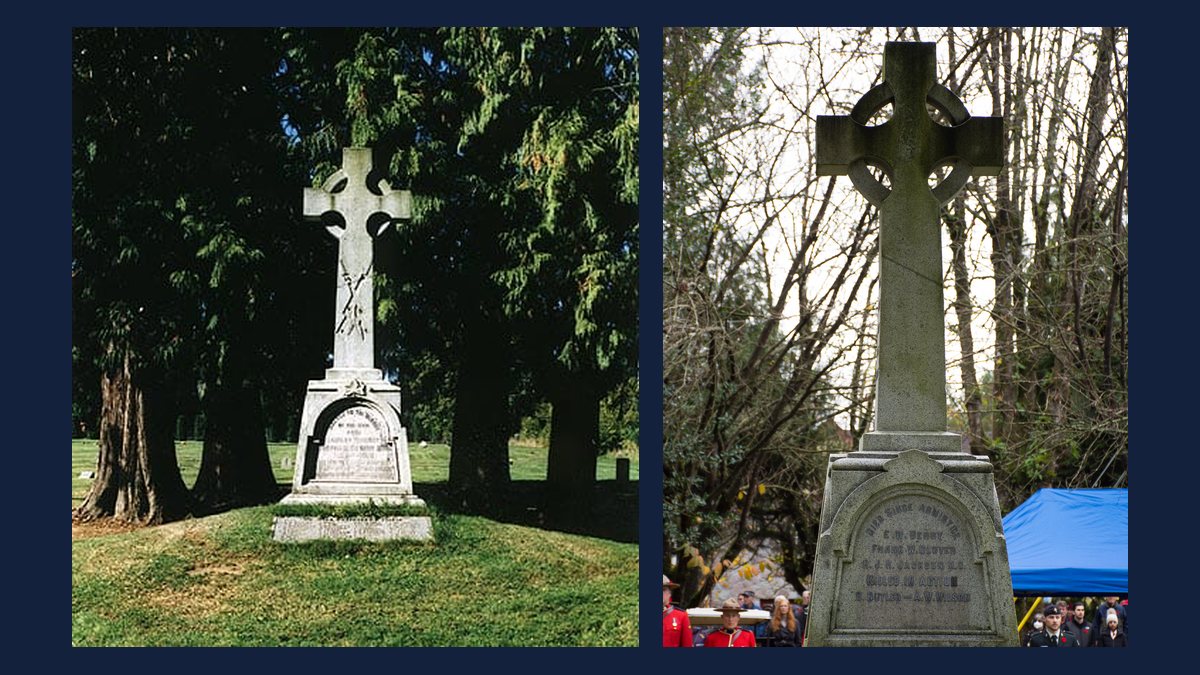
Langley has no single war memorial. It has a dozen, scattered across the City and the Township: two stone crosses in country cemeteries, a granite memorial in a city park, a cenotaph outside a Legion hall, a path of cedars, a stone from Korea, and trees planted a century ago for young men who didn’t come home. Here they are, with what each one says.
The twin crosses: Fort Langley and Murrayville
In 1920, two returned soldiers, Dr. Benjamin Marr and the municipal clerk Archie Payne, raised the money for a memorial in under a week. They chose a matching pair of stone Celtic crosses, one in the Fort Langley cemetery and one in the Murrayville cemetery. Fort Langley Remembers dates the unveiling to September 12, 1920, when Private Alf Trattle’s two young sons pulled the cover from the Fort Langley cross; the Township and some later accounts give 1921. At Murrayville, a younger brother of the airmen Ed and Bill Berry did the honours.
The crosses carry the same inscription:
SACRED TO THE MEMORY OF THE MEN FROM LANGLEY DISTRICT 1914-1918. THEY DIED THAT HONOUR MIGHT LIVE. IF YE KEEP NOT FAITH WE SHALL NOT SLEEP. ERECTED BY THE CITIZENS OF LANGLEY MUNICIPALITY.
They carry the same 41 First World War names, too, and after 1945 each got a panel with the 40 names from the Second World War, under the words “We will remember them.” You can read every name in our pieces on Langley in the First World War and the Second.
More than 500 veterans are buried between the two cemeteries.
Fort Langley’s ceremony had nearly faded away until local volunteers brought it back; it now draws thousands. A century of weather has been hard on the cross. In 2026 the Township reported a crack and a slight tilt, and repairs and a protective coating were under way.
Murrayville’s cross was restored in 2017, with a new concrete base and steps, and that November a local committee held the first official ceremony there. It now draws hundreds of people.
Douglas Park, Langley City
Langley City’s cenotaph is much younger. The City and the Langley Legion branch dedicated it on November 9, 2011. It’s built from three granite-clad slabs: a dark centre stone for past wars, loss and sorrow, and two lighter wings for protection and the hope of peace. The bronze “Crossed Rifles” sculpture was a gift from the Langley Heritage Society. The inscription reads Our Glorious Dead / Nos Morts Glorieux, and it remembers the First and Second World Wars and Korea. The City’s ceremony is held here.
Langley also had an older Legion cenotaph at 56 Avenue and Eastleigh Crescent, carved “Lest we forget / To our glorious dead,” with faces for both world wars and Korea, and one dedicated “In memory of Comrade Frank Flint.” It was taken down in 2011 and, as far as the records show, is in storage.
Aldergrove
The Aldergrove cenotaph stands outside Royal Canadian Legion Branch 265 on Fraser Highway. The branch built it and unveiled it on November 11, 1964, soon after the branch was formed. It reads Our Glorious Dead, with the dates of the two world wars and Korea. Beside it is the veterans’ mural the branch commissioned from the artist Dean Lauze in 1998, dedicated “To all men and women who served their country in times of war.”
Since Langley’s Branch 21 closed in 2018, after more than 90 years, Branch 265 and Cloverdale’s Branch 6 look after Langley between them.
The arboretum: Afghanistan, Korea and Vimy
Three of Langley’s newer memorials share the Derek Doubleday Arboretum on Fraser Highway.
A Walk to Remember. In January 2010, two Langley teenagers, Elizabeth and Michael Pratt, started looking for sponsors to plant a tree for every Canadian who died in the mission in Afghanistan: 158 soldiers and four civilians. The walk was dedicated on November 11, 2012. It’s lined with deodar cedars, a tree native to Afghanistan, and a steel ribbon carries the names. The Pratts received the Minister of Veterans Affairs Commendation in 2014.
The Gapyeong Stone. In January 2019, Gapyeong County in South Korea gave the Township a stone to thank Canada for the battle of Kapyong in April 1951, when the 2nd Battalion, Princess Patricia’s Canadian Light Infantry held the valley and, in the plaque’s words, “gave up not one foot of ground.” It was the first of six such stones in Canada, and in April 2026 Langley marked the battle’s 75th anniversary beside it.
The Vimy Oak. A sapling descended from the oaks of Vimy Ridge, planted in September 2017, a century after the battle.
The trees and the streets
After the First World War, Marr and Payne didn’t stop at stone. In 1923 they had maples planted for individual soldiers, and streets were named for the dead. Four of those maples are on record:
- Trattle, 96 Avenue at Trattle Street, Fort Langley: for Private Alfred Trattle, killed in 1917.
- Wright, 96 Avenue at Wright Street: for Sergeant Jesse Wright, his brother-in-law, killed near Vimy Ridge the same spring.
- Johnston, 216 Street at Glover Road, Milner: for Major Arthur Johnston, killed at Ypres in 1916.
- Wilson: William Wilson’s maple stood at Glover Road and 96 Avenue. When it came down it was milled into a memorial bench, which now stands at Heritage Manor with the tree’s plaque.
Eighteen horse chestnuts along Glover Road at Fort Langley were planted after the war as a living memorial. And the street names are memorials in plain sight: Allard, Trattle, Wright, Carvolth, Glover, Wilson, Henderson and Brown.
And one more
Langley Memorial Hospital is listed in the National Inventory of Canadian Military Memorials. In 1947 the community bought a surplus wartime hospital, moved it here from Boundary Bay, and opened it in 1948.
On November 11
Ceremonies are held at Douglas Park, Fort Langley, Murrayville and Aldergrove. See our Remembrance Day page for times, closures and parking.
Know of a memorial plaque, honour roll or memorial tree we’ve missed? Church halls and old community buildings often have them. Tell us.