- Communities
- Two, both in the Township of Langley: WindSong Cohousing (lived in since 1996) and Compass Commons (being built, move-in expected fall 2026)
- WindSong
- 20543 96 Avenue, Northwest Langley, just north of Walnut Grove · 34 townhomes around a glass-roofed street, 5,000 sq. ft. common house · windsong.bc.ca · [email protected]
- Compass Commons
- 6644 203 Street, near 203 Street and 66 Avenue in the Willowbrook area · 40 homes (36 condos, 4 townhouses), 4,300 sq. ft. common house · compasscohousing.com · [email protected]
- Ownership
- Strata title at both. You own your home outright, at market price, and can get an ordinary mortgage
- How to inquire
- WindSong: book a tour and join its interest list. Compass: sign up for an info session or see available homes
- Last checked
- November 26, 2026
The most common mix-up about cohousing in Langley is the word itself. People hear “cohousing” and think co-op, or commune, or subsidized housing. At WindSong, the community’s own site puts it bluntly: it is NOT cooperative housing. Both of Langley’s cohousing communities are strata developments, the same legal setup as any townhouse complex in Walnut Grove. What makes them different is the way the neighbours run the place, and the big shared building in the middle.
Langley has two. WindSong, on 96 Avenue in Northwest Langley, has been home to its residents since 1996. Compass Commons, near 203 Street and 66 Avenue, is the new one, with move-in expected this fall. Both are in the Township.
What is cohousing, in plain terms?
You buy your own home: your own front door, kitchen, bathrooms and bedrooms. On top of that, every household shares a “common house”, which is a much bigger amenity building than a normal strata would have, plus gardens, workshops and guest rooms. The homes are laid out so you bump into neighbours on the way in and out, and the residents make the decisions together, usually by consensus, instead of leaving everything to a property manager.
WindSong’s site sums up the distinction neatly: “cooperative” and “strata” describe who owns what, while cohousing describes how the community is governed.
WindSong: 30 years under a glass roof
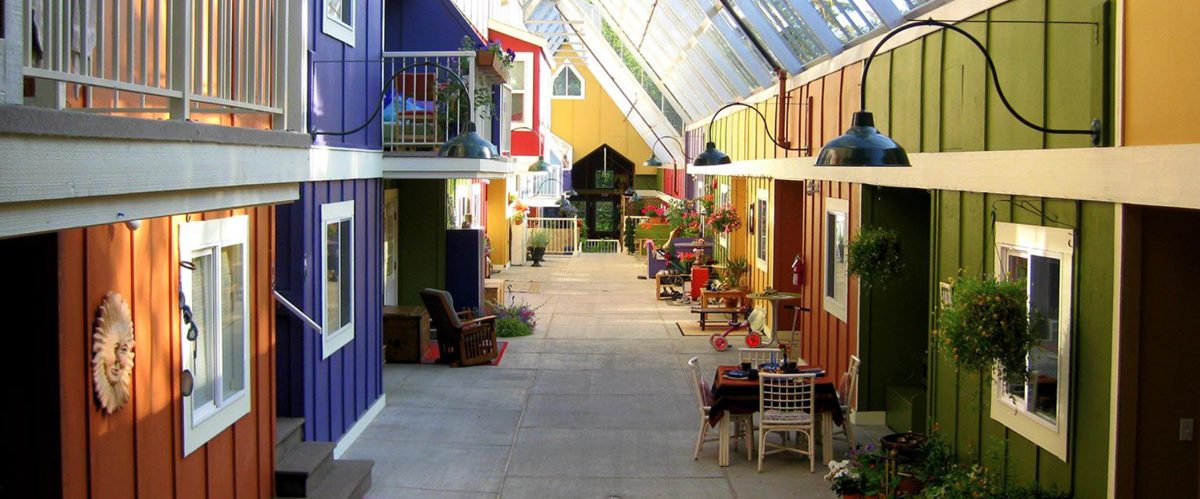
WindSong’s 34 townhomes sit in two long rows facing each other across an indoor street covered by a greenhouse-style glass roof, so kids can play and neighbours can stop to talk on a wet February night. The common house sits halfway along. Inside it, by WindSong’s own list: an industrial kitchen and dining room, a fireside lounge, a playroom with a loft, an arts and crafts room, a workshop, laundry, an exercise room, a media room, a guest room and an office.
The property is 5.8 acres, but only about 1.8 acres are built on. The rest is forest and wetland, with Yorkson Creek running through it, plus organic vegetable gardens and fruit trees. Homes come in three layouts, from a one-bedroom-plus-den on one level to a four-bedroom over three levels, between 687 and 1,609 square feet. Shortly after it was built, WindSong won a Georgie Award for Best Environmental Achievement and an Urban Development Institute award.
Around 90 to 100 people live there, from babies to retirees, and the site says neighbours get together through social events, shared meals and work parties. Taking part in the social side is optional, though.
How WindSong is run
Legally, WindSong is a strata corporation (it’s strata plan LMS 2427), so it holds the annual general meeting the Strata Property Act requires, passes a budget and sets strata fees. Day to day it uses sociocracy, a system of working groups it calls circles: five core circles cover the building and maintenance, governance, indoor spaces, outdoor spaces and “social fabric”, and each one gets its own budget to spend. The whole community meets once a month. Owners and renters alike are expected to pitch in with volunteer “sweat equity” as well as paying their monthly fees.
Getting in
Homes come up only now and then, and they sell or rent at market rates. WindSong says it isn’t set up to offer below-market housing. Its interest list is not a waitlist: signing up early doesn’t put you first in line. When a home comes up, things like how ready you are to move, how you fit with community life, and the seller’s own decision all count. Anyone thinking of buying or renting is invited to come on a tour, sit in on a community meeting and attend a social event first. Tours are led by residents, and WindSong asks for a $5 per person or $10 per family donation.
Compass Commons: the new one near Willowbrook
Compass Commons started out as Compass Cohousing (Compass Cohousing Ltd. is still the name of the company building it). It will have 40 strata-titled homes, 36 condos and 4 townhouses, at 6644 203 Street. The Canadian Cohousing Network listing describes a 4,300-square-foot common house with a big community kitchen and dining hall for shared meals, a lounge and media room, music room, workshop, fitness room, rooftop patio, guest suites, a laundry room and secure bike storage.
Its FAQ answers the questions buyers ask most. Your home is priced at market value, you can get a conventional mortgage, and once you hold strata title after occupancy you can sell at market value like any other condo. When we checked on November 26, 2026, its site still gave fall 2026 as the move-in date and listed five homes for sale: three townhouses and two condos.
When the Langley Advance Times wrote about the project in October 2022, the future residents were meeting every two weeks, making decisions by consensus. They planned to share tools, a snowblower and a lawnmower, and to book two guest suites when family visits instead of each keeping a spare room. One retired couple who had raised their kids in Surrey said they were downsizing partly because Compass welcomes grandchildren, while the bylaws at some age-restricted complexes they had toured weren’t as welcoming.
Cohousing vs co-op vs regular strata
The table is built from the Co-operative Housing Federation of BC, the Province’s strata guide and the two communities’ own sites.
| Cohousing (WindSong, Compass) | Housing co-op | Regular strata | |
|---|---|---|---|
| Who owns your home | You do, on strata title | The co-op does. You buy a share and become a member | You do, on strata title |
| What you pay | Purchase price, plus monthly strata fees | A share purchase (CHF BC says usually $1,000 to $7,000), then a monthly “housing charge” | Purchase price, plus monthly strata fees |
| Price | Market rate | Usually set to break even. Most BC co-ops are non-profit and some help lower-income members | Market rate |
| How you get in | Buy a home that comes up for sale. WindSong also has occasional rentals | Apply to that co-op. Waits of three months to three years or more are common | Buy one on the open market |
| When you leave | Sell at market value | Get your share back (no interest in a non-profit co-op) | Sell at market value |
| Who decides | All residents, usually by consensus, inside the strata’s legal framework | Members vote at general meetings and elect directors | Owners elect a strata council. Often a property manager runs things |
| Shared space | A large common house built for daily use, plus gardens and workshops | Varies by co-op | Varies. Usually a gym or party room at most |
For someone mostly looking for something cheaper, the co-op column is the one to read: cohousing in Langley costs about what any strata home costs. For someone who wants to own and also know their neighbours, cohousing is the closer fit. CHF BC runs a “Find a Co-op” directory, where you can filter for co-ops with open waitlists.
Questions people ask
Is it a seniors’ community? No. Both describe themselves as multigenerational, and WindSong has two playgrounds and an indoor playroom. Many people do choose cohousing when they downsize, though. If that’s you, our downsizing and moving help page and seniors’ guide are worth a look too.
Do I have to eat every meal with the neighbours? No. Both communities have a shared kitchen and dining room for group meals, but everyone has a full private kitchen, and WindSong says joining in socially is optional.
Can I rent? At WindSong, sometimes. Its sales page lists rentals now and then, and renters take part in community life like owners do. For renting more generally, see Renting in Langley.
Is there a waitlist? Not at WindSong, which keeps a notification list with no place in line. At Compass, you buy one of the homes still listed for sale.
What’s the neighbourhood like? WindSong sits on the northern edge of Walnut Grove, covered in our guide to Northwest Langley. Compass is a short walk from the shops in Willowbrook.
Something out of date? Tell us.
Last checked November 25, 2026. Spotted something out of date? Tell us.