- Where families farmed
- Fernridge, Coghlan, Otter, Milner, West Langley and the Langley Prairie rural routes
- Removed
- 1942, under a federal order covering the whole BC coast
- Farms sold
- 1943, without the owners' consent, mostly to the Veterans' Land Act
- Allowed back to the coast
- 1949
- See it in Langley
- The Sakamoto stone at Murrayville Cemetery
- Best museum
- Nikkei National Museum, Burnaby (free)
- Last checked
- November 18, 2026
On May 1, 1944, a Langley farmer named Keizo Fukumoto sat down in Raymond, Alberta, and wrote to the government office that had taken charge of his land. He’d just been told what his farm had sold for: $1,267. “To build the 250 or so feet of chicken houses of that size, alone, would easily cost that amount,” he wrote. “So do not sell the property at such a small sum.”
Two weeks later the Custodian’s Farm Department replied that his letter would be put on file. The sale had been part of “a policy of liquidation outlined by Ottawa”, and the office was “unable to consider any alternative.”
That’s the history in miniature. Japanese Canadian families farmed in Langley from the 1920s until 1942. Then they were removed from the coast, and in 1943 their farms were sold without their consent, most of them to a federal program that resettled returning soldiers. This page covers who they were, what happened, and where you can still find their story today.
Japanese Canadian farms in Langley before 1942
The Township of Langley’s own heritage study says Japanese labourers worked in Langley’s early logging and sawmills. Unlike the Chinese and Sikh workers of the time, who mostly came and went with the seasons, many Japanese families stayed. Between the wars they settled in Fern Ridge, Coghlan and West Langley, the study says, often on land other settlers hadn’t wanted, and built successful berry farms. The Province’s 2017 study of Japanese Canadian historic places names Aldergrove among the Fraser Valley districts where these farms did well.
The Custodian’s records add more places. They list families at Otter, Coghlan, Milner and along the rural routes out of Langley Prairie, including the Kitagawas on Berry Road South. Milner had a Japanese community hall, and it got a Custodian file of its own. The New Canadian, a Japanese Canadian newspaper, was still reporting on events at the Coghlan Japanese Hall in January 1940 and January 1941. Historian Anne Doré writes that Coghlan had a small nokai, a farmers’ association, where families pooled their crops and bought supplies together.
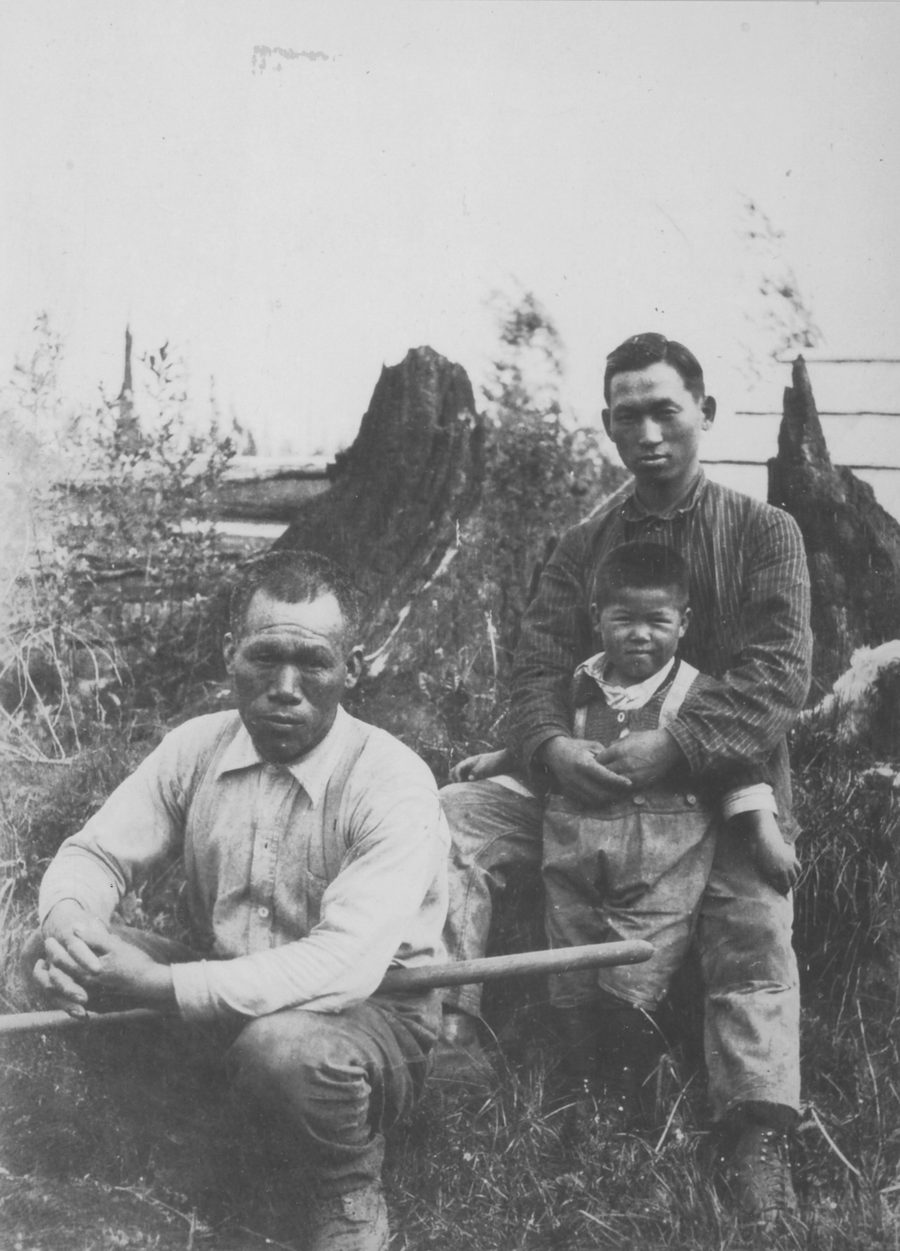
The Fukumotos farmed at Fernridge. A Langley Centennial Museum photo from about 1926 (the one at the top of this page) shows Keizo with his son Naoyuki, called Joe, and a friend, Masao Sugai, in front of the stumps of a half-cleared field. Joe was born in Fernridge in 1922 and went to Glenwood School. The Custodian’s file gives the family’s address as Sunnyside Road, Rural Route 2, Langley Prairie. Their land was two parcels, about 20 acres and 5 acres.
Not every neighbour was friendly. The same museum exhibit records that by 1921 the United Farmers in Langley were worried about the gains Japanese residents were making in fishing, shingle bolts and berries. In 1929 a Fort Langley man started the White Canada Association, which took its message to local farmers’ co-operatives.
1942: removal from Langley
On February 24, 1942, a federal order in council, P.C. 1486, gave the Minister of Justice control over everyone of Japanese origin in a “protected area” running 100 miles inland from the coast. Two days later all of them were ordered to leave. Langley was inside the line. Most of the roughly 22,000 people uprooted were Canadian citizens, by birth or by naturalization.
Langley’s farm families went different ways. The Fukumotos were sent to the sugar beet fields of southern Alberta: Raymond, and later Picture Butte. Joe was 20 and Canadian-born. The museum’s panel records that a neighbour looked after their farm and mailed them some money from the crops. Then he wrote to say he wasn’t allowed to do that any more. The Chibas, from beside South Otter School, were sent to the Tashme camp near Hope, a story we tell in full in The 39 acres at Otter Road.
What happened to the farms
At first, the government said property left behind was being held by the Custodian of Enemy Property as “a protective measure only.” Farms were treated differently. In June 1942 the Director of Soldier Settlement got the power to buy or lease Japanese Canadian farms, and that summer his appraisers went from farm to farm. Historian Ann Gomer Sunahara writes that they used cautious, Depression-era rules developed for drought-hit Saskatchewan. They gave no value to the crop in the ground and marked buildings down to 70 per cent of what they appeared to be worth.
In January 1943 the federal cabinet let the Custodian sell Japanese Canadian property without the owners’ consent. That June, the bulk of the farms outside Vancouver went to the Veterans’ Land Act in a single bulk deal. The one Japanese Canadian on the committee handling the sale, Yasutaro Yamaga, a Maple Ridge farmer, resigned in protest before it closed. Owners were told by letter, months later and hundreds of kilometres away. Fukumoto’s was dated April 13, 1944.
The land then went to veterans, the program our page on Langley’s soldier settlers follows. That page also tells how the two stories met at Coghlan, through the farmer Seiichi Kinoshita.
From 1947 to 1950 a royal commission under Justice Henry Bird, known as the Bird Commission, heard claims from Japanese Canadians that their property had been sold for less than it was worth. Keizo Fukumoto (case 462) and Seiichi Kinoshita of Coghlan (case 524) both filed claims, and both files survive at Library and Archives Canada.
Timeline
- 1920s and 1930s Japanese Canadian families settle and farm in Fernridge, Coghlan, Otter, Milner and West Langley.
- 1922 Joe Fukumoto is born in Fernridge. That year the Chibas and two neighbours sell an acre for South Otter School.
- 1929 The White Canada Association starts up in Fort Langley.
- 1940–1941 The New Canadian reports on events at the Coghlan Japanese Hall.
- February 24–26, 1942 P.C. 1486; everyone of Japanese origin is ordered off the coast.
- June 1942 The Director of Soldier Settlement gets power to buy or lease Japanese Canadian farms. Appraisers visit that summer.
- January 1943 Cabinet allows the Custodian to sell property without owners' consent.
- June 1943 The bulk sale of farms to the Veterans' Land Act is finalized.
- April–May 1944 Owners are told their sale prices. Keizo Fukumoto protests from Alberta and is refused.
- 1947–1950 The Bird Commission hears property claims.
- 1949 Japanese Canadians are allowed back to the coast.
- September 22, 1988 Prime Minister Brian Mulroney apologizes in the House of Commons.
- 2012 The BC Legislature apologizes.
- May 21, 2022 BC commits $100 million to Japanese Canadian legacies.
- October 2026 The Japanese Canadian Monument in Victoria is set to open, with a wall of names.
Where Japanese Canadian history is remembered today
In Langley. There’s very little to stand in front of. The clearest marker is at Murrayville Cemetery. In the old section, the Township’s cemetery tour points to a low, heavy granite marker, lettered in English, remembering the Sakamotos as “Father” and “Mother,” with the words “God is Love.” The tour says a few graves there mark the early Japanese Canadian presence in Langley.
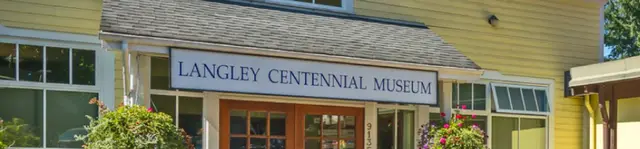
The Langley Centennial Museum told part of this story in its 2020–21 exhibit Roaring! Langley in the 1920s. The panel with the Fukumoto photo is still online through the Langley Heritage Society. The museum’s current exhibition, Langley: Many Voices, Shared Place, opened June 27, 2026, and is about the stories of how different people have made a home in Langley.
The Township’s 2017 heritage study names the Japanese Canadian districts. Of the 56 Japanese Canadian historic places the Province recognized in 2017, though, none is in Langley. The nearest Fraser Valley ones are Strawberry Hill in Surrey and Haney in Maple Ridge, along with the Fraser Valley Buddhist Temple, founded in 1954 by families who came back after the war.
Nikkei National Museum, Burnaby. The Nikkei National Museum & Cultural Centre is at 6688 Southoaks Crescent, Burnaby, and admission is free. Upstairs, the permanent exhibit TAIKEN: Generations of Resilience covers the prewar communities, the uprooting and what came after. From September to February the museum is open Tuesday to Sunday, 10am to 5pm, closed Mondays and statutory holidays; check its page for summer hours. Until February 28, 2027, the ground-floor gallery has DIS: displaced, dispersed, dispossessed, contemporary art about the lasting effects of the 1940s.
The monument in Victoria. BC’s 2022 redress package paid for survivors’ health and wellness, heritage sites, school curriculum and a monument. The monument, on Academy Close just south of St. Ann’s Academy, was developed with the Japanese Canadian Legacies Society. Its wall carries the names of the roughly 22,000 people uprooted, plus about 3,000 children born after the uprooting. It was set to open on October 3, 2026. If your family was from Langley, their names should be on it.
The records themselves. The University of Victoria’s Landscapes of Injustice archive has put thousands of Custodian files and Bird Commission claims online, scanned from originals at Library and Archives Canada. Search it for “Langley Prairie,” “Coghlan,” “Otter,” “Milner” or “Fernridge.” It’s free, and it’s the closest thing to a list of who lived here.
If you have a family photo or a story from Langley’s Japanese Canadian farms, we’d be glad to hear from you.
Something out of date? Tell us.
Last checked November 17, 2026. Spotted something out of date? Tell us.