- The era
- Roughly the 1880s to the 1920s, when settlers logged off the forest to make farms
- How many mills
- At least 78 sawmills, plus many portable ones, mostly around Murrayville, Aldergrove and Fern Ridge (Township of Langley, 2017)
- Walk it
- The Ravine Trail in Campbell Valley Regional Park follows an old logging railway bed, 1.8 km loop (Metro Vancouver)
- Dig deeper
- Alder Grove Heritage Society, 3190 271 Street, Aldergrove. Open Sundays 12 to 4 pm, admission by donation (AGHS)
- Last checked
- November 22, 2026
In 1915, wildfires ran across the whole Lower Mainland, and the Craig & Taylor lumber mill near Aldergrove came close to burning down. It survived. The Alder Grove Heritage Society says that a year later a mill in the Aldergrove area was cutting 52,000 feet of lumber in a single day.
That’s the scale of what happened here. Langley’s farms didn’t start out as open fields. Most of the Township was forest, and between the 1880s and the 1920s settlers, loggers and mill crews cut it down. The Township’s own heritage study counts at least 78 sawmills that worked in Langley, along with many portable ones, most of them around Murrayville, Aldergrove and Fern Ridge. Almost all of them were gone by the end of the 1920s. What’s left is mostly in the woods: a railway bed you can walk, old stumps with notches cut in them, and rotting trestle posts in a couple of creeks.
What the forest was like
The Township’s history describes coastal forest of huge Douglas fir, cedar, spruce, hemlock, maple and yew. For the Kwantlen and other Coast Salish peoples, western red cedar went into canoes, houses, clothing and ceremonial objects. Cedar bark is still stripped the traditional way, in a single strip that leaves the tree alive, and trees marked by that kind of harvest have been found on the grounds of Fort Langley National Historic Site.
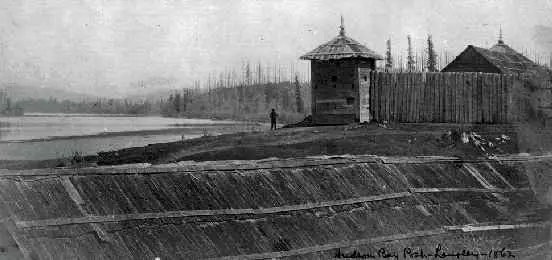
Fort Langley was in the timber trade early. By 1830, the Township’s study says, the fort was a major exporter of cedar lumber and shingles to Hawaii. The 1882–83 British Columbia Directory reported a new sawmill on the Fraser “a short distance above Fort Langley” and called it “a great boon in the neighbourhood.”
Clearing land for farms
For most homesteaders, logging was the first job, not a career. Metro Vancouver’s plan for Campbell Valley says the first settlers there “were tied closely to the logging.” The Township’s study says many pioneers in the Brookswood and Fernridge area set up sawmills as they logged off the first-growth timber on their land.
Fire cleared a lot of the land as well. The Alder Grove Heritage Society notes that a slash-and-burn fire got out of control and swept through the area in 1885. The 1892 Report on Agriculture found Hall’s Prairie and Glenwood heavily timbered, though much of the old growth in the eastern part had already burned.
The work wasn’t done by settlers alone. The Township’s study notes that Sikh and Japanese labourers made up a big share of the crews in early logging and milling across Langley, and Chinese workers were often hired to clear land. Our page on Japanese Canadian history in Langley shows how cedar shingle bolts, the blocks split into shingles, became part of that story by 1921.
Railways, spurs and “shoeflies”
The railways turned small woodlots into an industry. The Great Northern reached Langley in 1905, with stations at Aldergrove and at Lincoln, near Murrayville. The Township’s study says logging companies leased big timber holdings near Aldergrove because they could run spurs, called “shoeflies,” from the main line to their camps. Once the Great Northern line through South Langley was finished in 1909, the Fernridge Lumber Company built a spur to it within a year.
Langley Heritage Society railway volunteer Gerry Landsman describes the Great Northern’s subsidiary, the V.V. & E., looping south of Murrayville because the hills were too steep for a straight line. Inside that loop he places three sawmills: Fern Ridge Lumber Co. just west of 216 Street, McNair & Nicol east of it, and Maddough & Haggard/Langley Timber farther north. The V.V. & E. was abandoned in the late 1920s.
The BC Electric interurban opened through the middle of Langley in 1910. The Township’s study says it helped the mills by letting them lay a spur anywhere along the line. In Coghlan, according to the Aldergrove society’s book The Place Between, logging and mill work became the main way people made a living once the line was in. Freight cars of huge logs were a common sight, headed to a large mill called Beaver between County Line and Jackman roads.
The Aldergrove and Otter mills
Aldergrove had its own shingle mill just east of the downtown core, with a millpond on its west side. The heritage society has traced when the mill got electric power, and says that power later supplied the town until BC Electric expanded its service area. There was also a Fern Ridge shingle mill at Aldergrove, served by a Great Northern branch. The heritage society says the old Fernridge Mill stood on the bank of Bertrand Creek south of Fraser Highway.
Fire ended many of these mills. In 1924, the Otter Shingle Mill, beside the Salmon River where 248 Street crosses it, burned. So did the A.A. Rerrie mill, which by then stood at the southwest corner of today’s 264 Street and Robertson Crescent, on the old Great Northern route. The Otter mill was big enough to have a bookkeeper, Miles Walker, who also ran a small store there.
Timeline: Langley’s timber era
- By 1830: Fort Langley is a major exporter of cedar lumber and shingles to Hawaii.
- 1882–83: The BC Directory reports a new sawmill on the Fraser just above Fort Langley.
- 1885: A slash-and-burn fire gets out of control and sweeps through the area.
- 1892: The Report on Agriculture describes Hall’s Prairie and Glenwood as heavily timbered.
- 1905: The Great Northern reaches Langley, with stations at Aldergrove and Lincoln. Logging spurs follow.
- 1909–10: The Great Northern line through South Langley is finished, and the Fernridge Lumber Company builds a spur to it.
- 1910: The BC Electric interurban opens, and mills lay spurs along it.
- 1915: Wildfires sweep the Lower Mainland. The Craig & Taylor mill near Aldergrove narrowly survives.
- 1916: An Aldergrove-area mill cuts 52,000 feet of lumber in one day.
- 1920s: The good timber runs out. Mills close or burn and aren’t rebuilt, and a few carry on as shingle mills.
- 1924: The Otter Shingle Mill and the A.A. Rerrie mill are lost to fire.
- 1928: Langley Heritage Society’s 1920s exhibit shows the crew of the Flannigan sawmill that year.
- Late 1920s: The V.V. & E. line is abandoned.
Why the mills disappeared
The trees ran out. The Langley Heritage Society’s 1920s panel says the mills that had worked in Langley up to then began to vanish once the land was mostly cleared of usable timber. Several closed, others burned and were never rebuilt, and a handful kept going as shingle mills. The land went to dairy, berries and orchards, and the milk trains on the interurban took over from the log cars.
Some families carried on in a different form. Fred Loucks, whose family farmed on Zero Avenue east of 272 Street, built and ran sawmills all over Langley before starting a trucking company, according to the Langley Heritage Society. The Loucks house still stands on land Metro Vancouver bought for Aldergrove Regional Park.
What’s left to see
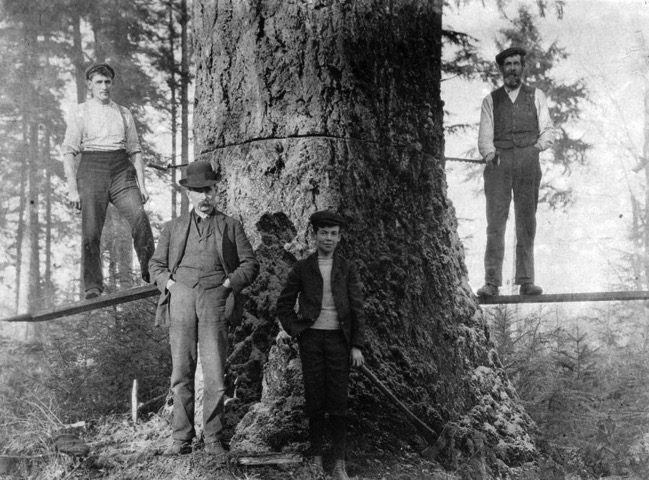
- The Ravine Trail, Campbell Valley Regional Park. Part of this 1.8 km loop runs along the bed of an old narrow-gauge railway that carried logs to a mill in the early 1900s. It has one steep hill, and the boardwalks get slippery when wet. The Township’s study says the whole park was clearcut and is now second-growth forest, with stumps more than two metres across that still show springboard notches. Loggers cut those slots so they could stand on a plank above the thick, flared base of the tree, as in the photo at the top of this page. Our Campbell Valley Regional Park page has the entrances, hours and parking.
- Trestle posts in Murray Creek. Old trestle posts in the creek near 40 Avenue, south of Murrayville, are probably from the V.V. & E., the Langley Heritage Society says, though they might be from one of the sawmills nearby. They’re on private property, not a public site. Our Brookswood guide has more on the line.
- Bertrand Creek pilings. The Alder Grove Heritage Society says Great Northern trestle pilings that once carried the line toward the Fernridge Mill are still in the overgrown creek.
- Old photos and records. The Alder Grove Heritage Society keeps photos of the downtown shingle mill and other Aldergrove history, and posts about mills on its site. For Langley-wide pictures, see where to find historical photos of Langley.
For the bigger picture of how Langley went from a fur-trade fort to farm country, start with our history of Langley.
Something out of date? Tell us.
Last checked November 21, 2026. Spotted something out of date? Tell us.