Langley in the Second World War: brothers, airmen and the 40 names added to the crosses
More than 650 young people from Langley served in the Second World War and about 40 did not come home, many of them brothers and many of them aircrew. Their stories, and what the war left behind in Langley.
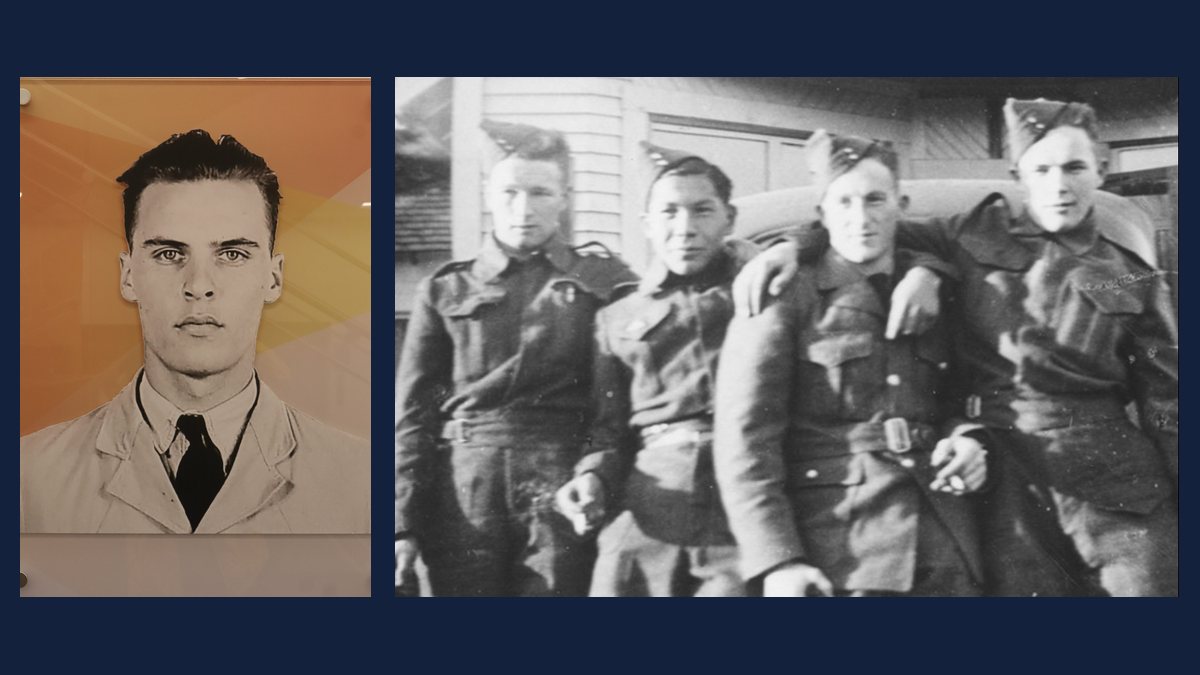
The second time, Langley knew what war cost. The district was bigger by 1939, though still mostly farms, and the names of the last war’s dead were already carved on its two stone crosses. More than 650 young men and women from Langley enlisted anyway. Men joined the army, the navy and, in large numbers, the air force; women served as nurses, cooks, radio operators, drivers, mechanics and clerks. By May 1945, about 41 of them had been killed.
What stands out, reading their records now, is how often the same surname appears twice. Or three times.
Three sons from Milner
Harry and Sylvia Kimmel farmed at Milner. Three of their sons went overseas with the army, and none came home.
Rifleman Gordon Kimmel of the Royal Winnipeg Rifles went missing in Normandy in the days after D-Day, in June 1944. He was 28, and married to a woman in England. Ten days later his brother, Corporal Richard Kimmel of the Regina Rifles, was killed in Normandy too, on June 18, at 30. That December, in Italy, Corporal Clifford Kimmel of the Hastings and Prince Edward Regiment was killed on December 5, at 24.
Gordon and Richard lie in the Canadian war cemeteries at Bretteville-sur-Laize and Bény-sur-Mer in Normandy. Clifford is at Ravenna. The Canadian Virtual War Memorial records that Sylvia Kimmel was later honoured as Canada’s National Silver Cross Mother, and tells a small, human story about it: the Langley and Mission Legion branches bought her a cloth coat for the ceremony in Ottawa, it turned out to be too light for the weather, and a department store let her choose another.
Two from Fort Langley
James and Kathleen Hadden of Fort Langley also lost two sons in Normandy, within six weeks of each other. Private George Hadden of the Canadian Scottish Regiment, born in Fort Langley in 1923, was killed on June 10, 1944, at 20. Rifleman James Hadden of the Regina Rifles, a year younger, was killed on July 19, at 19. They are buried in the same cemetery, at Bény-sur-Mer.
For the rest of her life, the Township says, Kathleen Hadden came to Remembrance Day as a Silver Cross mother often laying a wreath. She died in 1997.
The airmen
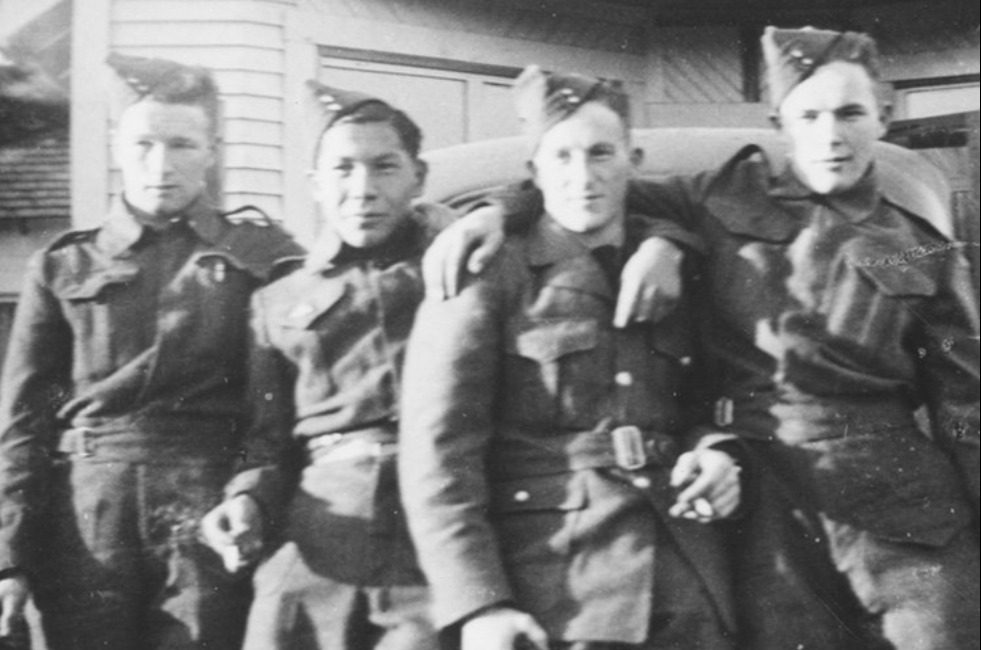
Langley gave a great many of its young men to the Royal Canadian Air Force, and the air war took them in ones and twos, often far from any battlefield. The Bomber Command Museum of Canada’s list of airmen lost, sorted by hometown, includes eighteen from Langley Prairie, Milner, Murrayville, Walnut Grove, Aldergrove and Langley. Several of them are on the crosses; two are remembered in Langley City place names, the pilots Jack Sendall and Lorne McBurney.
The Davies brothers of Walnut Grove. Pilot Officer Keith Davies was lost on February 24, 1942, and has no known grave; his name is on the Runnymede Memorial in England. His brother, Pilot Officer Douglas Davies, enlisted in Vancouver on November 11, 1941, and flew with 78 Squadron of Bomber Command. He was killed over France on June 13, 1944, at 21, and is buried with his crew in the churchyard at Poix-de-Picardie.
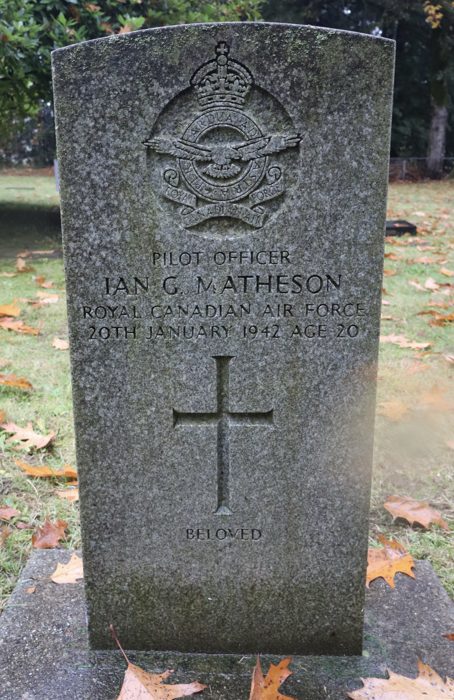
Pilot Officer Ian Matheson of Milner. A dairy-farm boy who went to Langley High School and studied aircraft construction by correspondence. He enlisted in May 1941 at 19 and his instructors marked him down as very good pilot material; he had his wings and his commission by December. On January 20, 1942, on his first day of training to become an instructor himself, his Harvard crashed near Aylmer, Ontario. He was 20. The United Church at Langley Prairie overflowed for his funeral, and he is buried in the family plot at Murrayville.
Warrant Officer James Toon of Murrayville. Son of Alphaeus and Eleanor Toon. He flew with 103 Squadron and was killed on April 14, 1943, at 23. He is buried at Le Mans, France.
Flight Sergeant Henry Zacharias, listed among Aldergrove’s airmen. An air bomber with 424 “Tiger” Squadron, he was on a night training flight from Skipton-on-Swale in Yorkshire on the night of January 21–22, 1944, when an engine failed and his Halifax came down in the River Swale. He was 22. His headstone at Harrogate reads: LORD, ABIDE WITH ME.
The Hough brothers of Coghlan
Gunner Harry Hough, born in Fort Langley in 1921, enlisted at New Westminster in 1940 and died on active service in Canada in October 1942, at 21. His brother, Gunner George Hough of the 3rd Field Regiment, whose parents George and Lizzie Hough lived on Coghlan Road, was killed in Italy on November 24, 1943, at 23, and lies at the Moro River Canadian War Cemetery. His headstone reads: WE WHO LOVED YOU SADLY MISS YOU AS IT DAWNS ANOTHER YEAR.
At home
Langley’s local unit was “C” Company of the 2nd Battalion, Westminster Regiment, which paraded on the Fraser Highway in 1940. When an attack on the coast felt possible, the 63rd Company of the Pacific Coast Militia Rangers stood guard here, part of a volunteer force of about 15,000 mostly older men across British Columbia. Adults joined Air Raid Precautions to enforce the blackout; spotters watched the sky. Women packed parcels for the men overseas, children dug Victory Gardens, and the Langley Advance printed the casualty lists every week. The ground floor of the Masonic Hall was set aside as an emergency hospital in case Vancouver was bombed.
In 1942 the Royal Canadian Navy chose Aldergrove for a radio station, and once it was running it handled the great bulk of the Navy’s communications traffic on the coast. It has worn several names since, from HMCS Aldergrove to CFS Aldergrove to Naval Radio Section Aldergrove, and it is still in service. (Our page on the naval radio station has more.)
What the war left
When the war ended, Langley still had no hospital. In April 1947 the hospital society bought a 67-bed wartime hospital from the War Assets Disposal Corporation for $9,500, to be moved up from Boundary Bay, and Langley Memorial Hospital opened in July 1948. It is listed today in the National Inventory of Canadian Military Memorials, although the listing doesn’t say why.
Returning veterans could buy land and build homes under the federal Veterans’ Land Act, passed in 1942.
The names
The Second World War names were added to the Fort Langley and Murrayville crosses on a panel that reads “1939 · We will remember them · 1945.”
R.H. Baxter · T.G. Baerg · C.J. Bennett · H. Cannell · J. Comish · J. Cowie · W. Dewar · D. Davies · K.S. Davies · W. Davidson · R. Duff · G.T. Eve · J.W.H. Frisby · W. Freeman · N. Fruno · J. Galbraith · V. Hayward · J.W.D. Hadden · J.C. Hadden · H. Hough · G.E. Jaynes · R. Jamieson · J. Jones · R. Kimmell · C.H. Kimmell · G.L. Kimmell · R. Kendall · G. Lang · L. Morris · R. Monahan · L. Marinello · R.E. McAuley · L. McBurney · H. Rolston · J. Sendall · G. Sawatzky · J.W. Toon · R.W. Woods · R. Warman · J.T. Yeomans
The spellings are the cenotaph’s own; the Kimmel brothers’ name is carved with a double L. Some Langley men who died, Ian Matheson among them, are not on the panel, a reminder that no list in stone is ever quite complete.
Find out more
- Search any name on the Canadian Virtual War Memorial.
- The Langley Heritage Society and the Langley Centennial Museum keep photographs and family stories; both welcome more.
- See our pieces on Langley in the First World War and Langley’s cenotaphs and memorials, and the Remembrance Day ceremonies.
We will remember them.