- How many
- More than 15 community halls in the Township of Langley, most of them heritage buildings, each run by a non-profit society (Township, via the Aldergrove Star, 2015)
- Oldest still in use as a hall
- Coghlan Hall in the Aldergrove area, built around 1920
- Heritage-designated halls
- Fort Langley (1979), Willoughby (2000), Murrayville (2001), plus the Sperling church and hall (1991) and Milner Chapel's hall, under a heritage revitalization agreement (Canada's Historic Places)
- Who built them
- Neighbours: volunteer labour, fundraising dances, donated land
- Can I go in?
- At a public event or by renting. Rates and capacities: halls and rooms for rent in Langley
- Last checked
- November 22, 2026
Langley’s old community halls were built by the neighbours who used them. Landowners gave the lots, families held dances in their homes to raise the money, and volunteers did the carpentry. The oldest still doing the job is Coghlan Hall, from around 1920. Fort Langley’s columned hall from 1931 is the grandest, and three halls (Fort Langley, Murrayville and Willoughby) are protected by heritage designation on their own. Nearly all are still run by volunteer societies, and you can rent most of them.
Here they are in the order they were built, along with a few that are gone or have been moved.
Why Langley built so many halls
Farms were far apart, and a hall was the one room big enough for the whole district. The Langley Heritage Society’s display on the 1920s lists what went on in them: polling stations, Great War Veterans’ Association meetings, farmers’ co-ops, women’s groups, cribbage leagues, whist drives, weddings, dances and fundraisers. The 1920s were the busiest decade for building, and land was often a gift. William Forman gave the lot for Coghlan Hall. Edward Stinchcombe, who owned the land under Fernridge Hall, handed it to the Fern Ridge Farmers’ Institute in 1927.
Women ran a lot of this. Fort Langley’s hall society chose a woman as its first president, Mrs. Hector Morrison, who also led the Fort Langley Women’s Institute. The national register calls that noteworthy for a time when men dominated civic life. In Willoughby, the register credits the community’s women with looking after the hall, a job the local Women’s Institute still does.
1898 or 1889: Otter’s first hall (moved, then sold)
Otter’s hall is a good example of how much the record disagrees. The Langley Heritage Society says it was built in 1898 on D.W. Poppy’s property and given to the new Otter Improvement Association in 1925. It was full most Saturday nights that decade, and in 1931 it was moved to Fraser Highway and 248 Street. The Alder Grove Heritage Society gives 1889 as the build year. It says the hall was shifted south when the Trans-Canada went through, rebuilt in 1948-49 and sold in 1959. Either way, by the Alder Grove society’s account the hall left community hands in 1959.
1911: Milner Hall, the dance hall upstairs
Bill Maxwell and Roy Hallack spent $4,000 on Milner Hall in 1911. It was two storeys, with dances, roller skating and good hardwood floors upstairs. According to the Heritage Society’s Milner timeline, it went broke during the First World War. A Royal Bank branch opened on its main floor in 1919, and Langley High School used the back of the building from 1922 until the new school on Yale Road was ready in 1924. Murrayville’s first hall was built around the same time on the same plan, a hall upstairs with shops below.
Around 1920: Coghlan Hall
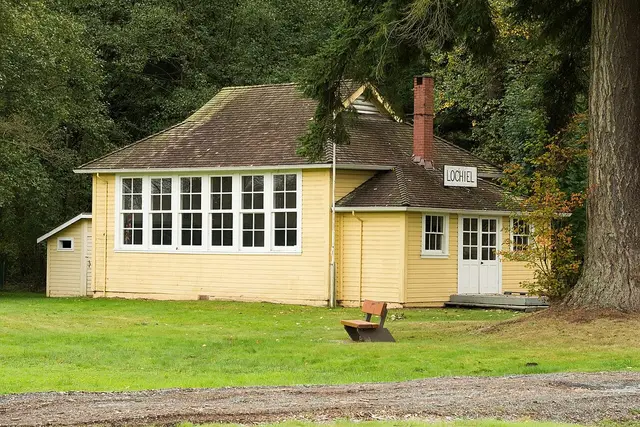
Coghlan Hall sits on 256 Street in the Aldergrove area, a few hundred feet east of the old interurban stop and across the tracks from the 1910 power station that ran the line. Coghlan is named for Nathaniel and Henry Coghlan, brothers who homesteaded here from 1884 and cut railway ties at their sawmill. For more than 80 years the Coghlan Community Association held Burns suppers, box socials, card parties, Women’s Institute meetings and polling days in the hall.
The Township lists it as a heritage character site rather than a listed building, because in the late 1970s or early 1980s its wood siding was covered in vinyl and the windows were replaced. The hall’s history page says that work could be reversed. The Aldergrove Fair association rents it out now. The floor is 29 by 43 feet and holds about 70 people. There’s a stage with wings and no kitchen.
1921 and 1924: Fernridge and the Athletic Park hall
Fernridge Hall went up on 24 Avenue in 1921. Langley Prairie, now Langley City, got the Langley Amateur Athletic Association’s hall at Athletic Park, today’s Douglas Park, in 1924. Both appear in the Heritage Society’s display on the 1920s building boom.
1925: Milner Chapel’s hall
The building most people now call Milner Chapel was built in 1886 as Langley Prairie Methodist Church. Pioneer Thomas Turnbull built it for $919.50 on land James M. Johnston donated. When the Methodists joined the United Church in 1925, a hall and kitchen went on the back. That addition gave the building its cross shape, with lapped siding that’s different from the church’s drop siding. The national register lists the site under a 2006 heritage revitalization agreement; the chapel’s own history gives an earlier designation date, February 7, 1983. It now stands in Milner Park, a short way south of its first site at Glover Road and 216 Street.
Services stopped in 1990. The Milner Community Association, revived in 1995, got the building back from the United Church to run it as a non-denominational chapel. It still runs it today with 11 elected directors. The chapel seats 90, the hall holds about 50 with its kitchen, and the association hosts the Milner Picnic every July. In 2014 the Township’s heritage advisory committee gathered Langley’s hall societies here for a workshop on keeping the halls going.
1928: Murrayville Community Memorial Hall
Murrayville’s first hall was upstairs over a toy factory and burned along with a neighbouring house. The Heritage Society blames a cigarette and dates the fire to 1921. The national register says 1924. Volunteers led by pioneer Ab Sherritt rebuilt in 1928 and named the hall for the First World War dead. In 1944 storekeeper P.Y. Porter sold the land to the hall association for one dollar, and he and his son looked after the building for decades.
Look for the odd roof, which is not quite a gabled hip, the narrow lapped siding and the scalloped shingles over the door. Inside, the original wood floor shows, but a proscenium arch and vaulted ceiling are hidden behind later changes. The Township designated it on June 25, 2001. The Murrayville Cribbage Club has played there every week since 1929, and the register calls it the hall’s longest-running user. The hall holds 200 and the association takes bookings online. For the neighbourhood around Five Corners, see our Murrayville guide. This year’s Remembrance display is in A pilot and a private.
1931: Fort Langley Community Hall
The Fort Langley Community Improvement Society was incorporated in 1924 to build a hall. It bought the old municipal hall’s lot from the Township for $137.13. Work began on October 15, 1930, with both volunteer and paid labour. The architect was A.C. Hope, a Vancouver school designer whose brother Charles lived in the village. MP Tom Reid opened the hall on March 6, 1931, at a ball for more than 600 people. Only the upstairs and one room were finished by then, and quilts hid the bare wall behind the stage. Directors planted the rows of maples along both side lines that same year. For decades a sign on the front gave the year as 1932. A film crew repaired it in 2020.
The register calls it a rare wooden classic revival building for the Fraser Valley: engaged Doric columns, a peaked hip roof, scalloped shingles, a curving drive, and upstairs a dance floor and proscenium arch. The Township designated it on September 10, 1979. The register says the hall, the Coronation Block and the CN station together built the support that led to the 1997 Fort Langley heritage conservation area. The society has always owned and run it, and it still holds markets, meetings and festivals. On screen it often plays a town hall, most famously in Sonic the Hedgehog 2. More on the village is in our Fort Langley village guide and living in Fort Langley.
1934, rebuilt 1979: West Langley Hall
The Langley Lions date the first West Langley Hall to 1934. Today’s log-style building in West Langley Park, in Walnut Grove, went up in 1979. The Lions meet there and manage it in partnership with the Township. It holds up to 240 theatre-style.
1937: Willoughby Community Hall
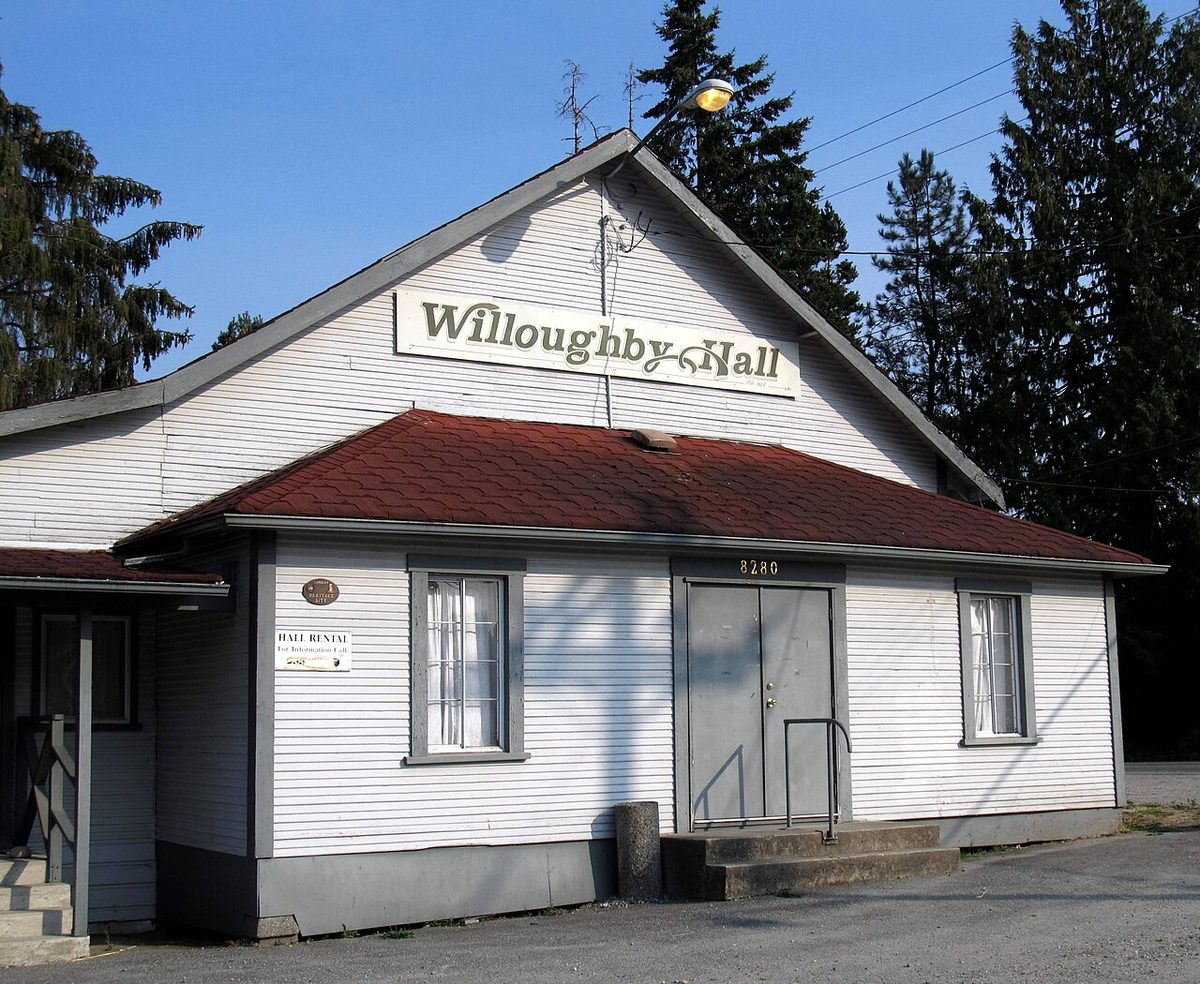
Willoughby only got its name in 1921. The register says the first hall went up in 1922, built by neighbours and first used as a school. The hall’s own history says 1921, and the Heritage Society’s display says 1924, adding that the money came from dances at people’s homes and the land from John Bray. After that hall burned, the community built the present cedar hall in 1937. The register prizes the hall’s plainness: a simple plan, a modest exterior and an entrance facing 208 Street.
In the mid-1960s the Willoughby Hall Society could no longer keep it going and handed the keys to Dalton Rooks of the Willoughby Saddle Club, who revived it with his wife Ann and a crew of volunteers. The Township designated it on August 14, 2000. In 2013 contractors winched the whole building a short way along its lot during a big renovation (our photo is from before the move). Inside, the original wood floor and 14-foot ceilings are still there. The hall holds 120, and the Women’s Institute that helps look after it is profiled on our Langley-Willoughby Women’s Institute page. The 1931 two-storey Willoughby school down the road is designated too; see one-room schoolhouses.
1953: Sperling’s church hall
Sperling was a 1910 BC Electric Railway flag stop, named for the railway’s general manager, and the area was known as Harmsworth before that. Its Methodist church opened in 1912. The small hall at the back came in 1953 and hosted Christmas concerts, dances, whist drives and cribbage. The church closed in 1969, and the pair was designated in 1991. When they went on the national register, the Township owned them and the Langley Heritage Society managed them. They stand at 240 Street and 72 Avenue.
1960: Aldergrove’s Heritage Hall
The newest hall on this list started as a provincial highways works yard on 273 Street. On May 6, 1960, the Aldergrove Old Age Pensioners Organization, Branch 71, was founded there. It leased the building from the Township for a dollar a year and later bought it. For decades it was “the OAP Hall”. In 2022 the pensioners and the Aldergrove Art Club renamed it Heritage Hall because people driving past assumed the fenced building was empty. Crib, whist, carpet bowling, dances and the Aldergrove Art Club keep it busy.
Seeing them for yourself
Most of these halls have no drop-in hours, so the way in is a public event or a rental. Our heritage buildings you can walk into lists the open ones. Rates, capacities and insurance rules are compared in halls and rooms for rent in Langley, and the wider list of designated buildings is on Langley heritage sites.
Something out of date? Tell us.
Last checked November 21, 2026. Spotted something out of date? Tell us.