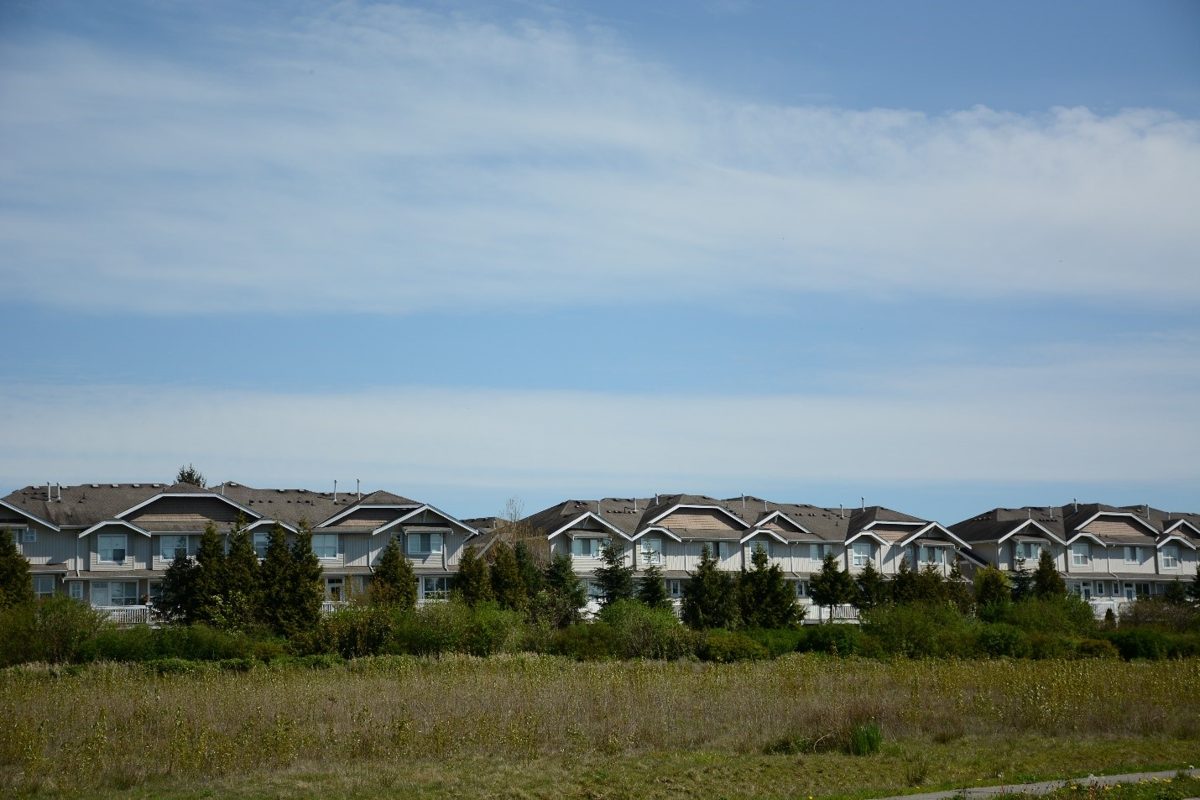
- Benchmark prices, Sept 2026
- Detached $1,471,100 · Townhouse $802,600 · Apartment $525,900 (FVREB)
- Transfer tax
- 1% on the first $200,000, 2% to $2 million, 3% above
- First-time buyer exemption
- Full up to $500,000; $8,000 off from $500,000 to $835,000; none from $860,000
- Speculation tax
- Both Langleys are taxable areas; owners still declare each year
- 2026 tax rate per $1,000
- City $4.2067 · Township $3.61686 (tax guide)
- Rules differ by municipality
- City vs Township
Most of the surprises in a Langley purchase are not the price. They are the costs layered on top of it, and a few local conditions that no listing mentions: a lot that sits in a floodplain, a “suite” that was never permitted, a well that nobody has tested. This guide puts the market in context first, then the taxes, then the checks.
What homes cost in Langley
The Fraser Valley Real Estate Board’s September 2026 package gives these MLS benchmark prices for Langley, which covers the City and the Township. A benchmark is the price of a typical home of that type, not an average or a listing.
| Home type | Benchmark, Sept 2026 | Change since Sept 2025 | Sales in September |
|---|---|---|---|
| Detached | $1,471,100 | -6.7% | 64 |
| Townhouse | $802,600 | -4.4% | 61 |
| Apartment | $525,900 | -9.2% | 67 |
For comparison, the Fraser Valley board as a whole had detached homes at $1,300,000, townhouses at $745,300 and apartments at $461,800 that month, so Langley sits above the regional figures in every category. FVREB also reported a 9% sales-to-active-listings ratio across its area and calls conditions a buyers’ market. Prices move monthly, so always open the latest package before you set a budget. FVREB’s figures do not split the City from the Township or one neighbourhood from another; the community guides (Willoughby, Walnut Grove, Brookswood and Fernridge and the rest) take that up where there is something to say.
What it costs on top of the price
Property transfer tax
BC charges 1% of fair market value on the first $200,000, 2% on the portion up to $2 million and 3% above that, plus another 2% on the residential portion above $3 million. Your lawyer or notary files and collects it at closing. Here is how that works at Langley’s September benchmarks, before any exemption:
| If you paid the benchmark | Transfer tax | First-time buyer exemption | You pay |
|---|---|---|---|
| Apartment, $525,900 | $8,518 | $8,000 | $518 |
| Townhouse, $802,600 | $14,052 | $8,000 | $6,052 |
| Detached, $1,471,100 | $27,422 | none (over $860,000) | $27,422 |
Those figures are our arithmetic from the Province’s published rates, assuming one buyer fully eligible. They are not a quote. The Province’s first-time buyer rules give full relief at $500,000 or less, an $8,000 exemption from $500,000 to $835,000, a sliding reduction to $860,000 and nothing above that. You must meet residency, tax-filing and never-owned-before tests, and if only some purchasers qualify the exemption is prorated. Properties over 0.5 hectares are measured differently, which matters for rural Langley.
New builds have their own exemption. A newly built principal residence can get full transfer-tax relief up to $1.1 million, tapering off before $1.15 million, with occupancy conditions. It is a separate program from the first-time buyer exemption, so check each. The federal first-time buyer GST rebate can return up to $50,000 on a new home priced up to $1 million (it shrinks to nothing by $1.5 million) for agreements signed from 20 March 2025 to 2031. Make sure the contract says whether the quoted price includes GST and any assigned rebate.
Other taxes people ask about
- Speculation and vacancy tax. Both Langleys are taxable areas. Every owner declares annually, and most owner-occupiers are exempt, but the declaration is not optional. For 2026 use, the non-exempt rate is 3% for foreign owners and owners with untaxed worldwide income, and 1% for other taxable owners, with the declaration due in 2027.
- Foreign-buyer tax. BC adds a further 20% additional transfer tax on residential property bought by foreign entities and taxable trustees in Metro Vancouver, with exemptions.
- Home flipping tax. In effect since January 2025: a sale of taxable residential property within 730 days can attract this tax, at 20% in the first 365 days and declining in the second year.
- Federal underused housing tax. Repealed in March 2026 for 2025 and later years, though filings for 2022 to 2024 still stand.
Property tax, every year
Property tax is billed by the City or Township and includes school, regional and TransLink levies. On a $1,000,000 assessment the 2026 rates produce $4,206.70 in the City and $3,616.86 in the Township. Why the gap, what each line pays for and what the grants do are in our property tax and utilities guide. The home owner grant threshold for 2026 is $2,075,000 in assessed value, and you must owe at least $350 in property tax to claim the regular grant.
Money you can plan around
- First Home Savings Account. Federal rules give $8,000 of annual room and a $40,000 lifetime limit, subject to your individual eligibility.
- Property tax deferment. A provincial loan, not a gift, and it charges interest. Read the terms before you rely on it.
- Secondary suite grants. The provincial suite incentive program stopped taking applications on 31 March 2025, so do not count on it in a renovation budget.
Langley-specific checks before you remove subjects
Which municipality, and what are the plans next door?
Look up the exact parcel on both the City and Township maps. Then read the development applications nearby. The Township reported 2,121 housing starts in 2025, and a lot of Willoughby is changing: the Township adopted a revised Willoughby Community Plan in June 2026 that replaced several older plans, including those for Carvolth and Latimer. A land-use designation on a plan is not a building permit, but it shows what could go next door. Our explainer on how development gets approved and the guide to following development applications show where to look.
Floodplain and drainage
Ask the municipality about the specific lot: floodplain restrictions, flood construction levels, any covenant and recorded drainage problems. Fraser freshet flooding and heavy-rain drainage problems are different risks, and a lot’s distance from a river does not settle either. The Township’s flooding page and the City’s emergency program are the starting points; safety in Langley covers the wider hazards.
The Agricultural Land Reserve
About 75% of the Township is in the ALR, so farmland is often your neighbour. If your lot is inside it, farming takes priority: non-farm uses, subdivision and second businesses are limited. If it borders it, expect tractors, dust, manure smells and early starts. Check the property on the Agricultural Land Commission’s map and read its buying and owning guidance. Our ALR explainer goes further, and rural Langley covers the lifestyle.
Suites, coach houses and “extra” units
Ask for permits, approved plans and occupancy records. In the Township, secondary suites carry extra utility charges. In the City, suite rules require an owner to live on site and cap suite size at the lesser of 100 m² or 40% of the building floor area. Neither a rental ad nor a second kitchen establishes legality. An unapproved suite brings enforcement risk for the owner and displacement risk for a tenant.
Small-scale multi-unit housing (SSMUH)
Provincial law now lets many single-family lots take three to six units. The Township’s version generally allows three units on eligible serviced lots of 280 m² or less and four on larger ones, inside its urban containment boundary; lots over 4,050 m², unserviced lots, heritage properties and transit-oriented areas follow different rules. The City’s bylaw 3300, adopted in March 2026, permits up to four units in R1 or six within 400 m of a qualifying frequent-transit stop, with a separate one-house-plus-one-suite regime for R1 lots in a transit-oriented area. Before you pay for a “development potential” lot, get the municipality to confirm the rules in writing and ask for a servicing and development cost charge estimate. The Township’s current DCC schedule dates from November 2025 with transition rules.
Strata
Ask for the Form B information certificate, minutes, budget, insurance summary, bylaws, depreciation report, parking and storage allocation and any special levies. A Form B is where the investigation begins, not where it ends. Strata corporations with five or more lots generally must have a depreciation report on a five-year cycle, and the transition deadline for Metro Vancouver strata was July 2026. In Langley, also check the visitor parking rules and whether a garage must stay available for a car: our parking guide explains why.
Rural homes: septic and wells
Many Langley properties outside the urban areas are not on municipal water or sewer. Request Fraser Health’s sewerage records, installation and maintenance documents and a qualified inspection, and check the system’s approved capacity against the house and any suite. For a well, ask for current water-quality results and yield information. A Langley address does not mean a sewer connection.
Noise, planes and trains
Langley Regional Airport (5385 216 Street) is a general-aviation airfield with fixed-wing and helicopter traffic; visit a candidate home while flying is under way. Freight rail and road crossings affect some neighbourhoods, and the Township has budgeted design work on whistle cessation, though that is not the same as horns stopping. Details are in getting around.
Presales and new construction
A presale contract is a bet on a building that does not exist yet. Read the disclosure statement and every amendment, the completion and extension clauses, how your deposit is held and what happens if the appraisal comes in below the price. BC’s real estate development rules generally give a seven-day rescission period, but the clock depends on signing and receiving the disclosure statement, so know the dates. New homes carry mandatory warranty coverage, commonly described as 2-5-10 years for materials and labour, the building envelope and the structure, with exclusions. Owner-built homes can be exempt, so check the BC Housing registry.
For resale purchases, BC’s Home Buyer Rescission Period gives three business days after acceptance to back out, for a fee of 0.25% of the price. It has exclusions and does not wait for subject removal, and it is a separate thing from the presale rule. BCFSA has the details.
A ten-point list for your lawyer and your inspector
- Municipality and zoning confirmed for the exact parcel.
- Floodplain, covenants and drainage history requested in writing.
- ALR status checked on the Commission’s map.
- Permit and occupancy records for any suite, addition or finished basement.
- Strata documents, including Form B and the depreciation report.
- Septic and well records and inspections, for rural homes.
- Property tax and utility bill history (see property tax and utilities).
- Your school catchment, checked at the SD35 locator (schools guide).
- A weekday drive of the real commute (getting around).
- Whether you are a first-time buyer, buying new, or both, and what that does to the tax.
Moving once you have the keys? Our newcomer checklist covers the first 30 days. Renting first instead? Start with renting in Langley.
Questions people ask about living in Langley
How much are houses in Langley right now?
How much property transfer tax will I pay in BC?
Is an $800,000 first home free of transfer tax?
Does Langley pay the speculation and vacancy tax?
Can I turn my Langley lot into a fourplex?
How do I check whether a Langley suite is legal?
What protection do I have buying a presale condo or townhouse in BC?
Is Langley a buyers' market?
Where can I check the assessed value and floodplain status of a specific Langley property?
Last checked October 29, 2026. Things change fast in a growing area: confirm anything important (catchments, rents, bus times) with the official source linked. Spotted something out of date? Tell us.